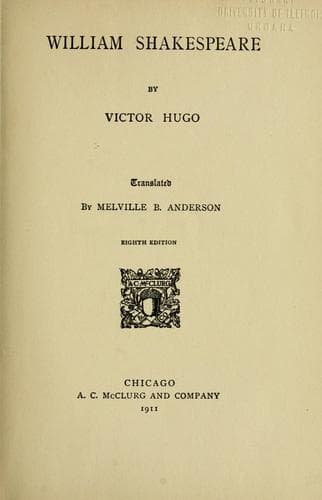
Dramatists, English -- Early modern, 1500-1700 -- Biography; Shakespeare, William, 1564-1616; Stratford-upon-Avon (England) -- Biography
Let us add that calumny loses its labour. Then what purpose can it
serve? Not even an evil one. Do you know anything more useless than the
sting which does not sting?
Better still. This sting is beneficial. In a given time it is found
that calumny, envy, and hatred, thinking to labour against, have worked
in aid of truth. Their insults bring fame, their blackening makes
illustrious. They succeed only in mingling with glory an outcry which
increases it.
Let us continue.
So, each of the men of genius tries on in his turn this immense human
mask; and such is the strength of the soul which they cause to pass
through the mysterious aperture of the eyes, that this look changes the
mask, and, from terrible, makes it comic, then pensive, then grieved,
then young and smiling, then decrepit, then sensual and gluttonous,
then religious, then outrageous; and it is Cain, Job, Atreus, Ajax,
Priam, Hecuba, Niobe, Clytemnestra, Nausicaa, Pistoclerus, Grumio,
Davus, Pasicompsa, Chimène, Don Arias, Don Diego, Mudarra, Richard
III., Lady Macbeth, Desdemona, Juliet, Romeo, Lear, Sancho Panza,
Pantagruel, Panurge, Arnolphe, Dandin Sganarelle, Agnes, Rosine,
Victorine, Basile, Almaviva, Cherubin, Manfred.
From the direct divine creation proceeds Adam, the prototype. From
the indirect divine creation,--that is to say, from the human
creation,--proceed other Adams, the types.
A type does not produce any man in particular; it cannot be exactly
superposed upon any individual; it sums up and concentrates under
one human form a whole family of characters and minds. A type is no
abridgment; it is a condensation. It is not one, it is all Alcibiades
is but Alcibiades, Petronius is but Petronius, Bassompierre is
but Bassompierre, Buckingham is but Buckingham, Fronsac is but
Fronsac, Lauzun is but Lauzun; but take Lauzun, Fronsac, Buckingham,
Bassompierre, Petronius, and Alcibiades, and pound them in the mortar
of imagination, and from that process you have a phantom more real
than them all,--Don Juan. Take the usurers one by one; no one of them
is that fierce merchant of Venice, crying, "Go, Tubal, fee me an
officer, bespeak him a fortnight before; I will have the heart of him
if he forfeit." Take all the usurers together; from the crowd of them
comes a total,--Shylock. Sum up usury, you have Shylock. The metaphor
of the people, who are never mistaken, confirms, without knowing it,
the inventions of the poet; and while Shakespeare makes Shylock, it
creates the _gripe-all._ Shylock is the Jewish bargaining. He is also
Judaism; that is to say, his whole nation,--the high as well as the
low, faith as well as fraud; and it is because he sums up a whole race,
such as oppression has made it, that Shylock is great. Jews, even
those of the Middle Ages, might with reason say that not one of them
is Shylock. Men of pleasure may with reason say that not one of them
is Don Juan. No leaf of the orange-tree when chewed gives the flavour
Public-domain text, read in full here on John Shaqi.
Reviews
Reviews
No reviews yet
Be the first to share your thoughts on this work.
Elsewhere in the archive
Join the Discussion
Join the discussion
Sign in to leave a comment or review.
Sign InorCreate an account