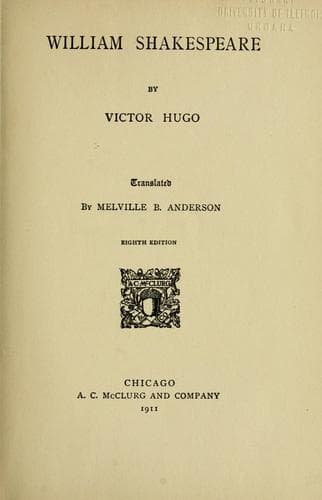
Dramatists, English -- Early modern, 1500-1700 -- Biography; Shakespeare, William, 1564-1616; Stratford-upon-Avon (England) -- Biography
of the orange, yet there is a deep affinity, an identity of roots, a
sap rising from the same source, the sharing of the same subterraneous
shadow before life. The fruit contains the mystery of the tree, and
the type contains the mystery of the man. Hence the strange vitality
of the type. For--and this is the prodigy--the type lives. If it were
but an abstraction, men would not recognize it, and would allow this
shadow to pass by. The tragedy termed classic makes larvæ; the drama
creates types. A lesson which is a man; a myth with a human face so
plastic that it looks at you, and that its look is a mirror; a parable
which warns you; a symbol which cries out "Beware!" an idea which
is nerve, muscle, and flesh, and which has a heart to love, bowels
to suffer, eyes to weep, and teeth to devour or laugh, a psychical
conception with the relief of actual fact, and which, if it bleeds,
drops real blood,--that is the type. O power of true poetry! Types are
beings. They breathe, palpitate, their steps are heard on the floor,
they exist. They exist with an existence more intense than that of any
creature thinking himself living there in the street. These phantoms
have more density than man. There is in their essence that amount of
eternity which belongs to _chefs-d'œuvre_, and which makes Trimalcion
live, while M. Romieu is dead.
Types are cases foreseen by God; genius realizes them. It seems that
God prefers to teach man a lesson through man, in order to inspire
confidence. The poet is on the pavement of the living; he speaks to
them nearer to their ear. Thence the efficacy of types. Man is a
premise, the type the conclusion; God creates the phenomenon, genius
puts a name on it; God creates the miser only, genius Harpagon; God
creates the traitor only, genius makes Iago; God creates the coquette,
genius makes Célimène; God creates the citizen only, genius makes
Chrysale; God creates the king only, genius makes Grandgousier.
Sometimes, at a given moment, the type proceeds complete from some
unknown partnership of the mass of the people with a great natural
comedian, involuntary and powerful realizer; the crowd is a mid-wife.
In an epoch which bears at one of its extremities Talleyrand, and at
another Chodruc-Duclos, springs up suddenly, in a flash of lightning,
under the mysterious incubation of the theatre, that spectre, Robert
Macaire.
Types go and come firmly in art and in Nature. They are the ideal
realized. The good and the evil of man are in these figures. From each
of them results, in the eyes of the thinker, a humanity.
Public-domain text, read in full here on John Shaqi.
Reviews
Reviews
No reviews yet
Be the first to share your thoughts on this work.
Elsewhere in the archive
Join the Discussion
Join the discussion
Sign in to leave a comment or review.
Sign InorCreate an account