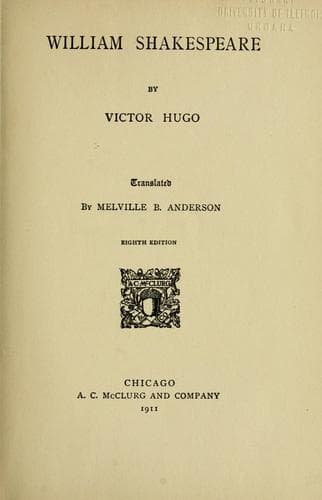
Dramatists, English -- Early modern, 1500-1700 -- Biography; Shakespeare, William, 1564-1616; Stratford-upon-Avon (England) -- Biography
Once this figure dreamed of and found, Shakespeare created his
drama. Where should he put this consoling vision? In an obscure age.
Shakespeare has taken the year of the world 3105, the time when
Joas was king of Judah, Aganippus, king of France, and Leir, king
of England. The whole earth was at that time mysterious. Represent
to yourself that epoch: the temple of Jerusalem is still quite new;
the gardens of Semiramis, constructed nine hundred years previously,
begin to crumble; the first gold coin appears in Ægina; the first
balance is made by Phydon, tyrant of Argos; the first eclipse of the
sun is calculated by the Chinese; three hundred and twelve years have
passed since Orestes, accused by the Eumenides before the Areopagus,
was acquitted; Hesiod is just dead; Homer, if he still lives, is a
hundred years old; Lycurgus, thoughtful traveller, re-enters Sparta;
and one may perceive in the depth of the sombre cloud of the East
the chariot fire which carries Elias away. It is at that period that
Leir--Lear--lives, and reigns over the dark islands. Jonas, Holofernes,
Draco, Solon, Thespis, Nebuchadnezzar, Anaximenes who is to invent the
signs of the zodiac, Cyrus, Zorobabel, Tarquin, Pythagoras, Æschylus,
are not born yet Coriolanus, Xerxes, Cincinnatus, Pericles, Socrates,
Brennus, Aristotle, Timoleon, Demosthenes, Alexander, Epicurus,
Hannibal, are larvæ waiting their hour to enter among men. Judas
Maccabæus, Viriatus, Popilius, Jugurtha, Mithridates, Marius and Sylla,
Cæsar and Pompey, Cleopatra and Antony, are far away in the future;
and at the moment when Lear is king of Brittany and of Iceland, there
must pass away eight hundred and ninety-five years before Virgil says,
"Penitus toto divisos orbe Britannos," and nine hundred and fifty
years before Seneca says "Ultima Thule." The Picts and the Celts (the
Scotch and the English) are tattooed. A redskin of the present day
gives a vague idea of an Englishman then. It is this twilight that
Shakespeare has chosen,--a broad night well adapted to the dream in
which this inventor at his pleasure puts everything that he chooses,
this King Lear, and then a King of France, a Duke of Burgundy, a Duke
of Cornwall, a Duke of Albany, an Earl of Kent, and an Earl of Gloster.
What does your history matter to him who has humanity? Besides, he
has with him the legend, which is a kind of science also, and as
true as history perhaps, but in another point of view. Shakespeare
agrees with Walter Mapes, archdeacon of Oxford,--that is something;
he admits, from Brutus to Cadwalla, the ninety-nine Celtic kings who
have preceded the Scandinavian Hengist and the Saxon Horsa: and since
he believes in Mulmutius, Cinigisil, Ceolulf, Cassibelan, Cymbeline,
Cynulphus, Arviragus, Guiderius, Escuin, Cudred, Vortigern, Arthur,
Uther Pendragon, he has every right to believe in King Lear, and to
create Cordelia. This land adopted, the place for the scene marked out,
Public-domain text, read in full here on John Shaqi.
Reviews
Reviews
No reviews yet
Be the first to share your thoughts on this work.
Elsewhere in the archive
Join the Discussion
Join the discussion
Sign in to leave a comment or review.
Sign InorCreate an account