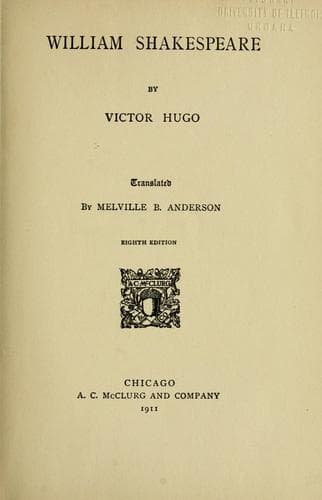
Dramatists, English -- Early modern, 1500-1700 -- Biography; Shakespeare, William, 1564-1616; Stratford-upon-Avon (England) -- Biography
The attentive man who reads great works feels at times, in the middle
of reading, certain sudden fits of cold followed by a kind of excess
of heat ("I no longer understand!--I understand!"), shivering and
burning,--something which causes him to be a little upset, at the same
time that he is very much struck. Only minds of the first order, only
men of supreme genius, subject to heedless wanderings in the infinite,
give to the reader this singular sensation,--stupor for most, ecstasy
for a few. These few are the _élite._ As we have already observed, this
_élite_, gathered from century to century, and always adding to itself,
at last makes up a number, becomes in time a multitude, and composes
the supreme crowd,--the definitive public of men of genius, sovereign
like them.
It is with that public that at the end one must deal.
Nevertheless, there is another public, other appraisers, other judges,
to whom we have lately alluded. They are not content.
The men of genius, the great minds,--this Æschylus, this Isaiah,
this Juvenal, this Dante, this Shakespeare,--are beings, imperious,
tumultuous, violent, passionate, extreme riders of winged steeds,
"overleaping all boundaries," having their own goal, which "goes beyond
the goal," "exaggerated," taking scandalous strides, flying abruptly
from one idea to another, and from the north pole to the south pole,
crossing the heavens in three steps, making little allowance for short
breaths, tossed about by all the winds, and at the same time full of
some unaccountable equestrian confidence amidst their bounds across the
abyss, untractable to the "aristarchs," refractory to state rhetoric,
not amiable to asthmatical _literati_, unsubdued to academic hygiene,
preferring the foam of Pegasus to asses' milk.
The worthy pedants are kind enough to be afraid for them. The ascent
gives rise to the calculation of the fall. The compassionate cripples
lament for Shakespeare. He is mad; he mounts too high! The crowd of
college fags (they are a crowd) look on in wonder, and get angry.
Æschylus and Dante make their connoisseurs blink their eyes every
moment. This Æschylus is lost! This Dante is near falling! A god is
soaring above; the worthy bourgeois cry out to him: "Look out for
yourself!"
CHAPTER V.
Besides, these men of genius disconcert.
One knows not on what to rely with them. Their lyric fever obeys
them; they interrupt it when they like. They seem wild. All at once
they stop. Their frenzy becomes melancholy. They are seen among the
precipices, alighting ou a peak and folding their wings, and then they
give way to meditation. Their meditation is not less surprising than
their transport. Just now they were soaring above, now they sink below.
But it is always the same boldness.
They are pensive giants. Their Titanic revery needs the absolute and
the unfathomable in which to expand. They meditate, as the sun shines,
with the abyss around them.
Public-domain text, read in full here on John Shaqi.
Reviews
Reviews
No reviews yet
Be the first to share your thoughts on this work.
Elsewhere in the archive
Join the Discussion
Join the discussion
Sign in to leave a comment or review.
Sign InorCreate an account