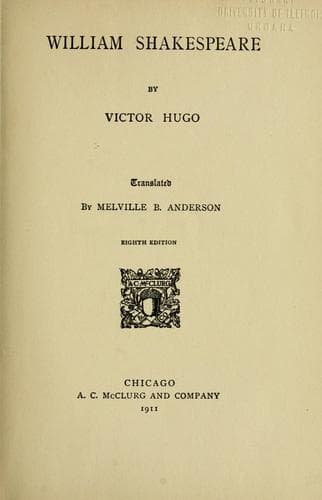
Dramatists, English -- Early modern, 1500-1700 -- Biography; Shakespeare, William, 1564-1616; Stratford-upon-Avon (England) -- Biography
Their moving to and fro in the ideal gives the vertigo. Nothing is too
lofty for them, and nothing too low. They pass from the pygmy to the
Cyclops, from Polyphemus to the Myrmidons, from Queen Mab to Caliban,
and from a love affair to a deluge, and from Saturn's ring to the doll
of a little child. _Sinite parvulos venire._ One of the pupils of their
eye is a telescope, the other a microscope. They investigate familiarly
these two frightful opposite depths,--the infinitely great and the
infinitely small.
And one should not be angry with them; and one should not reproach
them for all this! Indeed! Where should we go if such excesses were
to be tolerated? What! No scruple in the choice of subjects, horrible
or sad; and the idea, even if it be disquieting and formidable,
always followed up to its extreme limits, without pity for their
fellow-creatures! These poets only see their own aim; and in everything
are immoderate in their way of doing things. What is Job?--a worm on
an ulcer. What is the Divina Commedia?--a series of torments. What
is the Iliad?--a collection of plagues and wounds; not an artery
cut which is not complaisantly described. Go round for opinions on
Homer: ask of Scaliger, Terrasson, Lamotte, what they think of him.
The fourth of an ode to the shield of Achilles--what intemperance! He
who does not know when to stop never knew how to write. These poets
agitate, disturb, trouble, upset, overwhelm, make everything shiver,
break things, occasionally, here and there. They can cause great
misfortunes; it is terrible. Thus speak the Athenæa, the Sorbonnes, the
sworn-in professors, the societies called learned, Saumaise, successor
of Scaliger at the university of Leyden, and the _bourgeoisie_ after
them,--all who represent in literature and art the great party of
order. What can be more logical? The cough quarrels with the hurricane.
Those who are poor in wit are joined by those who have too much wit.
The septics lend assistance to the fools. Men of genius, with few
exceptions, are proud and stem; that is in the very marrow of their
bones. They have in company with them Juvenal, Agrippa d'Aubigné,
and Milton; they are prone to harshness; they despise the _panem et
circenses_; they seldom grow sociable, and they growl. People rail at
them in a pleasant way. Well done.
Public-domain text, read in full here on John Shaqi.
Reviews
Reviews
No reviews yet
Be the first to share your thoughts on this work.
Elsewhere in the archive
Join the Discussion
Join the discussion
Sign in to leave a comment or review.
Sign InorCreate an account