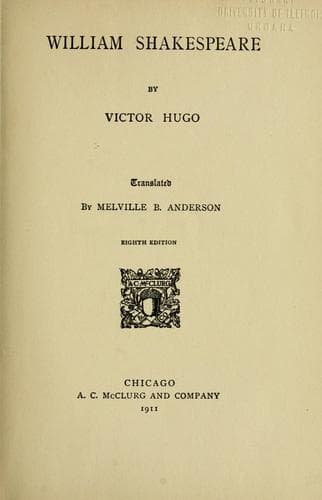
Dramatists, English -- Early modern, 1500-1700 -- Biography; Shakespeare, William, 1564-1616; Stratford-upon-Avon (England) -- Biography
Ah, poet! Ah, Milton! Ah, Juvenal!--ah, you keep up resistance! ah,
you perpetuate disinterestedness! ah, you bring together these two
firebrands, faith and will, in order to make the flame burst out from
them! ah, there is something of the Vestal in you, old grumbler! ah,
you have an altar,--your country! ah, you. have a tripod,--the ideal!
ah, you believe in the rights of man, in emancipation, in the future,
in progress, in the beautiful, in the just, in what is great! Take
care; you are behindhand. All this virtue is infatuation. You emigrate
with honour; but you emigrate. This heroism is no longer the fashion.
It no longer suits our epoch. There comes a moment when the sacred fire
is no longer fashionable. Poet, you believe in right and truth; you are
behind your century. Your very eternity causes you to pass away.
So much the worse, without doubt, for those grumbling geniuses
accustomed to greatness, and scornful of what is no longer so. They
are slow in movement when shame is at stake; their back is struck with
anchylosis for anything like bowing and cringing. When success passes
along, deserved or not, but saluted, they have an iron bar keeping
their vertebral column stiff. That is their affair. So much the worse
for those people of old-fashioned Rome. They belong to antiquity and
to antique manners. To bristle up at every turn may have been all very
well in former days. Those long bristling manes are no longer worn;
the lions are out of fashion now. The French Revolution is nearly
seventy-five years old. At that age dotage comes. The people of the
present time mean to belong to their day, and even to their minute.
Certainly, we find no fault with it. Whatever is, must be. It is quite
right that what exists should exist The forms of public prosperity
are various. One generation is not obliged to imitate another. Cato
copied Phocion; Trimalcion is less like,--it is independence. You
bad-tempered old fellows, you wish us to emancipate ourselves? Let it
be so. We disencumber ourselves of the imitation of Timoleon, Thraseas
Artevelde, Thomas More, Hampden. It is our fashion to free ourselves.
You wish for a revolt; there it is. You wish for no insurrection; we
rise up against our rights. We affranchise ourselves from the care
of being free. To be citizens is a heavy load. Eights entangled with
obligations are restraints to whoever desires to enjoy life quietly.
To be guided by conscience and truth in all the steps that we take
is fatiguing. We mean to walk without leading-strings and without
principles. Duty is a chain; we break our irons. What do you mean by
speaking to us of Franklin? Franklin is a rather too servile copy of
Aristides. We carry our horror of servility so far as to prefer Grimod
de la Reynière. To eat and drink well, there is purpose in that. Each
epoch has its peculiar manner of being free. Orgy is a liberty. This
way of reasoning is triumphant; to adhere to it is wise. There have
Public-domain text, read in full here on John Shaqi.
Reviews
Reviews
No reviews yet
Be the first to share your thoughts on this work.
Elsewhere in the archive
Join the Discussion
Join the discussion
Sign in to leave a comment or review.
Sign InorCreate an account