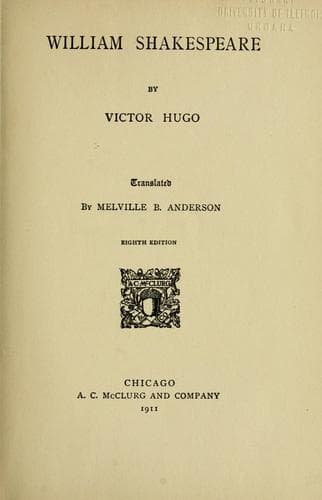
Dramatists, English -- Early modern, 1500-1700 -- Biography; Shakespeare, William, 1564-1616; Stratford-upon-Avon (England) -- Biography
What then? No criticising? No.--No blame? No.--You explain everything?
Yes.--Genius is an entity like Nature, and requires, like Nature, to
be accepted purely and simply. A mountain must be accepted as such or
left alone. There are men who would make a criticism on the Himalayas,
pebble by pebble. Mount Etna blazes and slavers, throws out its glare,
its wrath, its lava, and its ashes; these men take scales and weigh
those ashes, pinch by pinch. _Quot libras in monte summo?_ Meanwhile
genius continues its eruption. Everything in it has its reason for
existing. It is because it is. Its shadow is the inverse of its light.
Its smoke comes from its flame. Its depth is the result of its height.
We love this more and that less; but we remain silent wherever we feel
God. We are in the forest; the tortuosity of the tree is its secret.
The sap knows what it is doing. The root knows its own business. We
take things as they are; we are indulgent for that which is excellent,
tender, or magnificent; we acquiesce in _chefs-d'œuvre_; we do not
make use of one to find fault with the other; we do not insist upon
Phidias sculpturing cathedrals, or upon Pinaigrier glazing temples
(the temple is the harmony, the cathedral is the mystery; they are two
different forms of the sublime); we do not claim for the Münster the
perfection of the Parthenon, or for the Parthenon the grandeur of the
Münster. We are so far whimsical as to be satisfied with both being
beautiful. We do not reproach for its sting the insect that gives us
honey. We renounce our right to criticise the feet of the peacock, the
cry of the swan, the plumage of the nightingale, the butterfly for
having been caterpillar, the thorn of the rose, the smell of the lion,
the skin of the elephant, the prattle of the cascade, the pips of the
orange, the immobility of the Milky Way, the saltness of the ocean, the
spots on the sun, the nakedness of Noah.
The _quandoque bonus dormitat_ is permitted to Horace. We raise
no objection. What is certain is, that Homer would not say it of
Horace,--he would not take the trouble. Himself the eagle, Homer would
indeed find Horace, the chattering humming-bird, charming. I grant
it is pleasant to a man to feel himself superior, and say, "Homer is
puerile; Dante is childish." It is indulging in a pretty smile. To
crush these poor geniuses a little, why not? To be the Abbé Trublet,
and say, "Milton is a schoolboy," it is pleasing. How witty is the man
who finds that Shakespeare has no wit! That man is La Harpe, Delandine,
Auger; he is, was, or shall be, an Academician. "All these great men
are made up of extravagance, bad taste, and childishness." What a fine
decree to issue! These fashions tickle voluptuously those who have
them; and in reality, when they have said, "This giant is small,"
they can fancy that they are great. Every man has his own way. As for
myself, the writer of these lines, I admire everything like a fool.
That is why I have written this book.
Public-domain text, read in full here on John Shaqi.
Reviews
Reviews
No reviews yet
Be the first to share your thoughts on this work.
Elsewhere in the archive
Join the Discussion
Join the discussion
Sign in to leave a comment or review.
Sign InorCreate an account