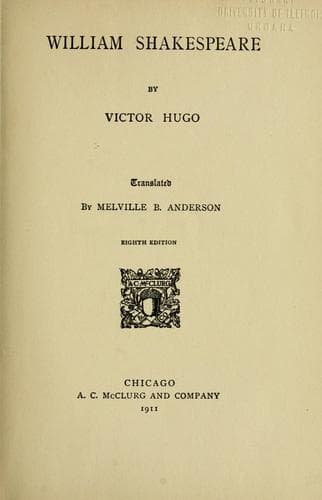
Dramatists, English -- Early modern, 1500-1700 -- Biography; Shakespeare, William, 1564-1616; Stratford-upon-Avon (England) -- Biography
At the very moment we finished writing the pages you have just read,
was announced in London the formation of a committee for the solemn
celebration of the three-hundredth anniversary of the birth of
Shakespeare. This committee will dedicate to Shakespeare, on the 23d
April, 1864, a monument and a festival which will surpass, we doubt
not, the incomplete programme we have just sketched out. They will
spare nothing. The act of admiration will be a striking one. One may
expect everything, in point of magnificence, from the nation which
has created the prodigious palace at Sydenham, that Versailles of a
people. The initiative taken by the committee will doubtless secure
the co-operation of the powers that be. We discard, for our part, and
the committee will discard, we think, all idea of a manifestation by
subscription. A subscription, unless of one penny,--that is to say,
open to all the people,--is necessarily fractional. What is due to
Shakespeare is a national manifestation;--a holiday, a public _fête_,
a popular monument, voted by the Chambers and entered in the Budget
England would do it for her king. Now, what is the King of England
beside the man of England? Every confidence is due to the Jubilee
Committee of Shakespeare,--a committee composed of persons highly
distinguished in the press, the peerage, literature, the stage, and
the church. Eminent men from all countries, representing intellect
in France, in Germany, in Belgium, in Spain, in Italy, complete this
committee, in all points of view excellent and competent. Another
committee, formed at Stratford-on-Avon, seconds the London committee.
We congratulate England.
Nations have a dull ear and a long life,--which latter makes their
deafness by no means irreparable: they have time to change their mind.
The English are awake at last to their glory. England begins to spell
that name, Shakespeare, upon which the universe has laid her finger.
In April, 1664, a hundred years after Shakespeare was born, England was
occupied in cheering loudly Charles II., who had sold Dunkirk to France
for two hundred and fifty thousand pounds sterling, and in looking at
something that was a skeleton and had been Cromwell, whitening under
the north-east wind and rain on the gallows at Tyburn. In April, 1764,
two hundred years after Shakespeare was born, England was contemplating
the dawn of George III.,--a king destined to imbecility,--who at that
epoch, in secret councils, and in somewhat unconstitutional asides
with the Tory chiefs and the German Landgraves, was sketching out that
policy of resistance to progress which was to strive, first against
liberty in America, then against democracy in France, and which, during
the single ministry of the first Pitt, had, in 1778, raised the debt of
England to the sum of eighty millions sterling. In April, 1864, three
hundred years since Shakespeare's birth, England raises a statue to
Shakespeare. It is late, but it is well.
BOOK II.
THE NINETEENTH CENTURY.
Public-domain text, read in full here on John Shaqi.
Reviews
Reviews
No reviews yet
Be the first to share your thoughts on this work.
Elsewhere in the archive
Join the Discussion
Join the discussion
Sign in to leave a comment or review.
Sign InorCreate an account