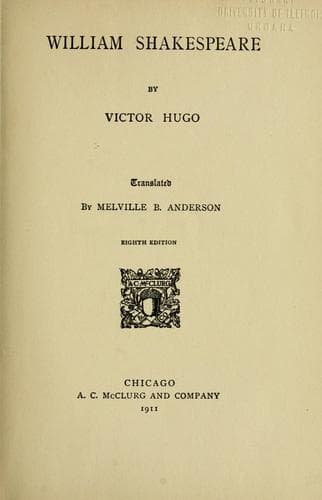
Dramatists, English -- Early modern, 1500-1700 -- Biography; Shakespeare, William, 1564-1616; Stratford-upon-Avon (England) -- Biography
The bold ones continue; those predestined persist. The dreadful
declivity sinks beneath them and tries to draw them in; glory is
traitorous. They are eyed by the eagles; the lightning plays about
them; the hurricane is furious. No matter, they persevere. They ascend.
He who arrives at the summit is thy equal, Homer!
Those names that we have mentioned, and those which we might have
added, repeat them again. To choose between these men is impossible.
There is no method for striking the balance between Rembrandt and
Michael Angelo.
And, to confine ourselves solely to the authors and poets, examine them
one after the other. Which is the greatest? Every one.
1. One, Homer, is the huge poet-child. The world is born, Homer sings.
He is the bird of this aurora. Homer has the holy sincerity of the
early dawn. He almost ignores shadow. Chaos, heaven, earth; Geo and
Ceto; Jove, god of gods; Agamemnon, king of kings; peoples; flocks
from the beginning; temples, towns, battles, harvests; the ocean;
Diomedes fighting; Ulysses wandering; the windings of a sail seeking
its home; Cyclops; dwarfs; a map of the world crowned by the gods of
Olympus; and here and there a glimmer of the furnace permitting a
sight of hell; priests, virgins, mothers; little children frightened
by the plumes; the dog who remembers; great words which fall from
gray-beards; friendships, loves, passions, and the hydras; Vulcan for
the laugh of the gods, Thersites for the laugh of men; two aspects of
married life summed up for the benefit of ages in Helen and Penelope;
the Styx; Destiny; the heel of Achilles, without which Destiny would
be vanquished by the Styx; monsters, heroes, men; thousands of
landscapes seen in perspective in the cloud of the old world,--this
immensity, this is Homer. Troy coveted, Ithaca desired. Homer is war
and travel,--the first two methods for the meeting of mankind. The
camp attacks the fortress, the ship sounds the unknown, which is
also an attack; around war every passion; around travels every kind
of adventure,--two gigantic groups; the first, bloody, is called the
Iliad; the second, luminous, is called the Odyssey. Homer makes men
greater than Nature; they hurl at each other rocks which twelve pairs
of oxen could not move. The gods hardly care to come in contact with
them. Minerva takes Achilles by the hair; he turns round in anger:
"What do you want with me, goddess?" No monotony in these puissant
figures. These giants are graduated. After each hero, Homer breaks the
mould. Ajax, son of Oïleus, is less high in stature than Ajax, son of
Telamon. Homer is one of the men of genius who resolve that beautiful
problem of art (the most beautiful of all, perhaps),--the true picture
of humanity obtained by aggrandizing man; that is to say, the creation
of the real in the ideal. Fable and history, hypothesis and tradition,
the chimera and knowledge, make up Homer. He is fathomless, and he
is cheerful. All the depth of ancient days moves happily radiant and
Public-domain text, read in full here on John Shaqi.
Reviews
Reviews
No reviews yet
Be the first to share your thoughts on this work.
Join the Discussion
Join the discussion
Sign in to leave a comment or review.
Sign InorCreate an account