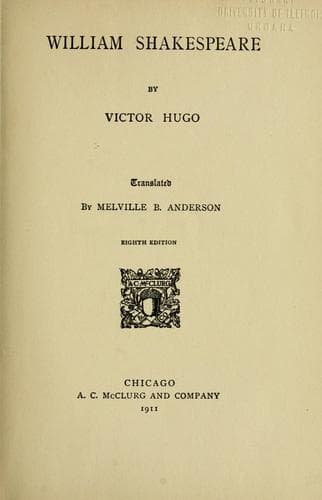
Dramatists, English -- Early modern, 1500-1700 -- Biography; Shakespeare, William, 1564-1616; Stratford-upon-Avon (England) -- Biography
Nothing can be insignificant that relates to war, the warrior, the
prince, the throne, the court. He who is not endowed with grave
puerility cannot be a historian. A question of etiquette, a hunt, a
gala, a grand levee, a procession, the triumph of Maximilian, the
number of carriages the ladies have following the king to the camp
before Mons, the necessity of having vices congenial with the faults
of his majesty, the clocks of Charles V., the locks of Louis XVI.; how
the broth refused by Louis XV. at his coronation, showed him to be a
good king; how the Prince of Wales sits in the Chamber of the House
of Lords, not in the capacity of Prince of Wales, but as Duke of
Cornwall; how the drunken Augustus has appointed Prince Lubormirsky,
who is starost of Kasimirow, under-cupbearer to the crown; how Charles
of Spain gave the command of the army of Catalonia to Pimentel because
the Pimentels have the title of Benavente since 1308; how Frederic of
Brandenburg granted a fief of forty thousand crowns to a huntsman who
enabled him to kill a fine stag; how Louis Antoine, grand-master of
the Teutonic Order and Prince Palatine, died at Liége from displeasure
at not being able to make the inhabitants choose him bishop; how the
Princess Borghèse, dowager of Mirandole and of the Papal House, married
the Prince of Cellamare, son of the Duke of Giovenazzo; how my Lord
Seaton, who is a Montgomery, followed James II. into France; how the
Emperor ordered the Duke of Mantua, who is vassal of the empire, to
drive from his court the Marquis Amorati; how there are always two
Cardinal Barberins living, and so on,--all that is the important
business. A turned-up nose becomes an historical fact. Two small fields
contiguous to the old Mark and to the duchy of Zell, having almost
embroiled England and Prussia, are memorable. In fact the cleverness of
the governing and the apathy of the governed have arranged and mixed
things in such a manner that all those forms of princely nothingness
have their place in human destiny; and peace and war, the movement of
armies and fleets, the recoil or the progress of civilization, depend
on the cup of tea of Queen Anne or the fly-flap of the Dey of Algiers.
History walks behind those fooleries, registering them.
Public-domain text, read in full here on John Shaqi.
Reviews
Reviews
No reviews yet
Be the first to share your thoughts on this work.
Elsewhere in the archive
Join the Discussion
Join the discussion
Sign in to leave a comment or review.
Sign InorCreate an account