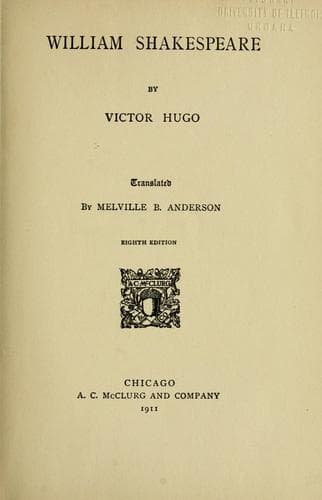
Dramatists, English -- Early modern, 1500-1700 -- Biography; Shakespeare, William, 1564-1616; Stratford-upon-Avon (England) -- Biography
Knowing so many things, it is quite natural that it should be ignorant
of others. If you are so curious as to ask the name of the English
merchant who in 1612 first entered China by the north; of the worker
in glass who in 1663 first established in France a manufactory of
crystal; of the citizen who carried out in the States General at Tours,
under Charles VIII.: the sound principle of elective magistracy (a
principle which has since been adroitly obliterated); of the pilot
who in 1405 discovered the Canary Islands; of the Byzantine lutemaker
who in the eighth century invented the organ and gave to music its
grandest voice; of the Campanian mason who invented the clock by
establishing at Rome on the temple of Quirinus the first sundial;
of the Roman lighterman who invented the paving of towns by the
construction of the Appian Way in the year 312 B.C.; of the Egyptian
carpenter who devised the dove-tail, one of the keys of architecture,
which may be found under the obelisk of Luxor; of the Chaldean keeper
of flocks who founded astronomy by his observation of the signs of
the zodiac, the starting-point taken by Anaximenes; of the Corinthian
calker who, nine years before the first Olympiad, calculated the power
of the triple lever, devised the trireme, and created a tow-boat
anterior by two thousand six hundred years to the steamboat; of the
Macedonian ploughman who discovered the first gold mine in Mount
Pangæus,--history, does not know what to say to you: those fellows are
unknown to history. Who is that,--a ploughman, a calker, a shepherd,
a carpenter, a lighterman, a mason, a lutemaker, a sailor, and a
merchant? History does not lower itself to such rabble.
There is at Nüremberg, near the Egydienplatz, in a chamber on the
second floor of a house which faces the church of St Giles, on an
iron tripod, a little ball of wood twenty inches in diameter, covered
with darkish vellum, marked with lines which were once red, yellow,
and green. It is a globe on which is sketched out an outline of the
divisions of the earth in the fifteenth century. On this globe is
vaguely indicated, in the twenty-fourth degree of latitude, under
the sign of the Crab, a kind of island named Antilia, which one day
attracted the attention of two men. The one who had constructed the
globe and draw Antilia showed this island to the other, placed his
finger upon it, and said, "It is there." The man who looked on was
called Christopher Columbus; the man who said, "It is there," was
called Martin Behaim. Antilia is America. History speaks of Fernando
Cortez, who ravaged America, but not of Martin Behaim, who divined it.
Let a man have "cut to pieces" other men; let him have "put them to the
sword;" let him have made them "bite the dust,"--horrible expressions,
which have become hideously familiar,--and if you search history for
the name of that man, whoever he may be, you will find it. But search
for the name of the man who invented the compass, and you will not find
it.
Public-domain text, read in full here on John Shaqi.
Reviews
Reviews
No reviews yet
Be the first to share your thoughts on this work.
Elsewhere in the archive
Join the Discussion
Join the discussion
Sign in to leave a comment or review.
Sign InorCreate an account