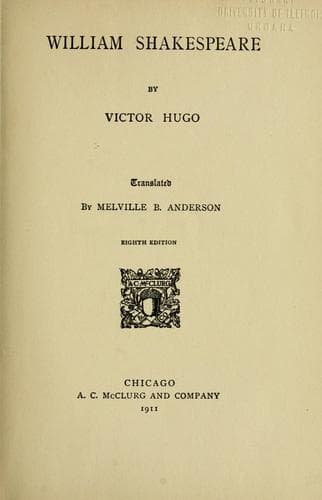
Dramatists, English -- Early modern, 1500-1700 -- Biography; Shakespeare, William, 1564-1616; Stratford-upon-Avon (England) -- Biography
verse 3 of chap. III. to the end. He was good; he did not meet a poor
child without throwing him the small coin kesitha; he was "the foot
of the lame man, and the eye of the blind." It is from that that he
was precipitated; fallen, he became gigantic. The whole poem of "Job"
is the development of this idea,--the greatness that may be found at
the bottom of the abyss. Job is more majestic when unfortunate than
when prosperous. His leprosy is a purple cloth. His misery terrifies
those who are there; they speak not to him until after a silence of
seven days and seven nights. His lamentation is marked by they know
not what quiet and sad sorcery. As he is crushing the vermin on his
ulcers, he calls on the stars. He addresses Orion, the Hyades, which he
names the Pleiades, and the signs that are at noonday. He says, "God
has put an end to darkness." He calls the diamond which is hidden,
"the stone of obscurity." He mixes with his distress the misfortune of
others, and has tragic words that freeze,--"The widow is desolate." He
smiles also, and is then more frightful yet. He has around him Eliphaz,
Bildad, Zophar,--three implacable types of the friendly busybody,
of whom he says, "You play on me as on a tambourine." His language,
submissive toward God, is bitter toward kings: "The kings of the earth
build solitudes," leaving our wit to find out whether he speaks of
their tomb or their kingdom. Tacitus says, "Solitudinem faciunt." As
to Jehovah, he adores him; and under the furious scourging of the
plagues, all his resistance is confined to asking of God, "Wilt thou
not permit me to swallow my spittle?" That dates four thousand years
ago. At the same hour, perhaps, when the enigmatical astronomer of
Denderah carves in the granite his mysterious zodiac, Job engraves
his on human thought; and his zodiac is not made of stars, but of
miseries. This zodiac turns yet above our heads. We have of Job only
the Hebrew version, written by Moses. Such a poet, followed by such
a translator, makes us dream! The man of the dunghill is translated
by the man of Sinai. It is that, in reality, Job is a minister and a
prophet. Job extracts from his drama a dogma. Job suffers, and draws an
inference. Now, to suffer and draw an inference is to teach; sorrow,
when logical, leads to God. Job teaches. Job, after having touched the
summit of the drama, stirs up the depths of philosophy. He shows first
that sublime madness of wisdom which, two thousand years later, by
resignation making itself a sacrifice, will be the foolishness of the
cross,--_stultitiam crucis._ The dunghill of Job, transfigured, will
become the Calvary of Jesus.
Public-domain text, read in full here on John Shaqi.
Reviews
Reviews
No reviews yet
Be the first to share your thoughts on this work.
Join the Discussion
Join the discussion
Sign in to leave a comment or review.
Sign InorCreate an account