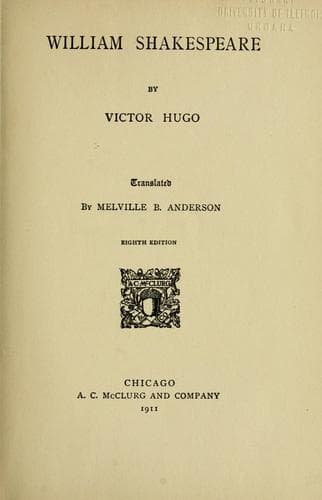
Dramatists, English -- Early modern, 1500-1700 -- Biography; Shakespeare, William, 1564-1616; Stratford-upon-Avon (England) -- Biography
Is not everything there? Search for a higher formula, you will not
find it. A free man under a sovereign God. This visionary eater of
dung is a resuscitator. Ezekiel has mud on the lips and sun in the
eyes. Among the Jews the reading of Ezekiel was dreaded. It was not
permitted before the age of thirty years. Priests, disturbed, put a
seal on this poet. People could not call him an impostor. His terror
as a prophet was incontestable. He had evidently seen what he related.
Thence his authority. His very enigmas made him an oracle. They could
not tell which it was, these women sitting toward the north weeping for
Tammuz. Impossible to divine what was the "hasmal," this metal which he
pictured as in fusion in the furnace of the dream; but nothing was more
clear than his vision of Progress. Ezekiel saw the quadruple man,--man,
ox, lion, and eagle; that is to say, the master of thought, the master
of the field, the master of the desert, the master of the air. Nothing
forgotten. It is posterity complete, from Aristotle to Christopher
Columbus, from Triptolemus to Montgolfier. Later on, the Gospel also
will become quadruple in the four Evangelists, making Matthew, Mark,
Luke, and John subservient to man, the ox, the lion, and the eagle,
and, remarkable fact, to symbolize progress will take the four faces
of Ezekiel. At all events, Ezekiel, like Christ, calls himself the
"Son of Man." Jesus often in his parables invokes and cites Ezekiel;
and this kind of first Messiah paves the way for the second. There are
in Ezekiel three constructions,--man, in whom he places progress; the
temple, where he puts a light that he calls glory; the city, where
he puts God. He cries to the temple,--no priest here, neither they,
nor their kings, nor the carcasses of their kings.[2] One cannot help
thinking that this Ezekiel, a species of biblical demagogue, would help
'93 in the terrible sweeping of St. Denis. As for the city built by
him, he mutters above it this mysterious name, Jehovah Schammah, which
signifies "the Eternal is there." Then he is silent and thoughtful in
the darkness, pointing at humanity; farther on, in the depth of the
horizon, a continued increase of azure.
Public-domain text, read in full here on John Shaqi.
Reviews
Reviews
No reviews yet
Be the first to share your thoughts on this work.
Join the Discussion
Join the discussion
Sign in to leave a comment or review.
Sign InorCreate an account