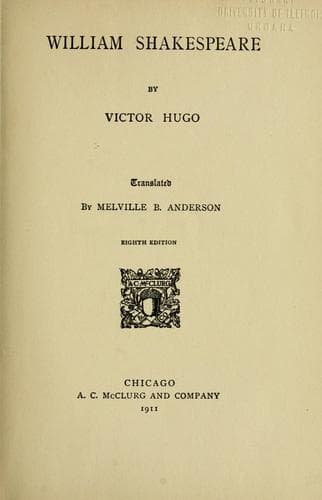
Dramatists, English -- Early modern, 1500-1700 -- Biography; Shakespeare, William, 1564-1616; Stratford-upon-Avon (England) -- Biography
6. Another, Lucretius, is that vast obscure thing, All. Jupiter is
in Homer; Jehovah is in Job; in Lucretius Pan appears. Such is Pan's
greatness that he has under him Destiny, which is above Jupiter.
Lucretius has travelled and he has mused, which is another voyage.
He has been at Athens; he has been in the haunts of philosophers; he
has studied Greece and made out India. Democritus has made him dream
on matter, and Anaximander on space. His dreams have become doctrine.
Nothing is known of the incidents of his life. Like Pythagoras, he
frequented the two mysterious schools on the Euphrates,--Neharda and
Pombeditha; and he may have met there the Jewish doctors. He spelt
the papyri of Sepphoris, which, at his time, was not yet transformed
into Diocæsarea. He lived with the pearl-fishers of the isle of Tylos.
We may find in the Apocrypha traces of an ancient strange itinerary
recommended, according to some, to the philosophers by Empedocles, the
magician, of Agrigentum, and, according to others, to the rabbis by
the high-priest Eleazer who corresponded with Ptolemy Philadelphus.
This itinerary would have served at a later time as a standard for the
travels of the Apostles. The traveller who followed this itinerary went
through the five satrapies of the country of the Philistines, visited
the people who charm serpents and suck poisonous sores,--the Psylli;
drank of the torrent Bosor, which marks the frontier of Arabia Deserta;
then touched and handled the bronze _carcan_ of Andromeda, still
sealed to the rock of Joppa; Balbec in Syria; Apamea, on the Orontes,
where Nicanor nourished his elephants; the harbour of Eziongeber,
where the vessels of Ophir, laden with gold, stopped; Segher, which
produced white incense, preferred to that of Hadramauth; the two
Syrtes, the mountain of Emerald Smaragdus; the Nasamones, who pillaged
the shipwrecked; the black nation, Agysimba; Adribe, the town of
crocodiles; Cynopolis, town of aloes; the wonderful cities of Comagena,
Claudia, and Barsalium; perhaps even Tadmor, the town of Solomon,--such
were the stages of this almost fabulous pilgrimage of the thinkers.
This pilgrimage, did Lucretius make it? One cannot tell. His numerous
travels are beyond doubt He had seen so many men that at the end they
were all mixed up in his eye, and this multitude had become to him
shadows. He is arrived at that excess of simplification of the universe
which is almost its entire fading away. He has sounded until he feels
the plummet float He has questioned the vague spectres of Byblos; he
has conversed with the severed tree of Chyteron, who is Juno-Thespia.
Perhaps he has spoken in the reeds to Oannes, the man-fish of Chaldæa,
who had two heads,--at the top the head of a man, below the head of
a hydra, and who, drinking chaos by his lower orifice, re-vomited it
on the earth by his upper lip; in knowledge awful. Lucretius has this
knowledge. Isaiah borders on the archangels, Lucretius on larvas.
Public-domain text, read in full here on John Shaqi.
Reviews
Reviews
No reviews yet
Be the first to share your thoughts on this work.
Join the Discussion
Join the discussion
Sign in to leave a comment or review.
Sign InorCreate an account