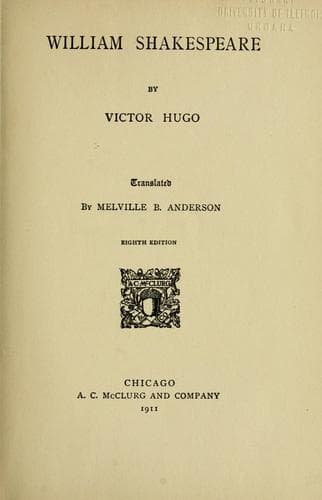
Dramatists, English -- Early modern, 1500-1700 -- Biography; Shakespeare, William, 1564-1616; Stratford-upon-Avon (England) -- Biography
This half-possession of death
gives him a personal certainty, and one often distinctly apart from
the dogma, and a mark of conviction on his personal conceptions, which
makes him almost heretical. His humility, bordering on the mysterious,
is lofty. Peter says, "The words of Paul may be taken in a bad sense."
The deacon Hilaire and the Luciferians ascribe their schism to the
Epistles of Paul. Paul is at heart so anti-monarchical that King James
I., very much encouraged by the orthodox University of Oxford, caused
the Epistle to the Romans to be burned by the hand of the common
hangman. It is true it was one with a commentary by David Pareus. Many
of Paul's works are rejected by the Church: they are the finest; and
among them his Epistle to the Laodiceans, and above all his Apocalypse,
erased by the Council of Rome under Gelasius. It would be curious to
compare it with the Apocalypse of John. On the opening that Paul had
made to heaven the Church wrote, "Entrance forbidden." He is not less
holy for it. It is his official consolation. Paul has the restlessness
of the thinker; text and formulary are little for him. The letter does
not suffice; the letter, it is matter. Like all men of progress, he
speaks with reserve of the written law; he prefers grace, as we prefer
justice. What is grace? It is the inspiration from on high; it is the
breath, _flat ubi vult_; it is liberty. Grace is the spirit of law.
This discovery of the spirit of law belongs to Saint Paul; and what
he calls "grace" from a heavenly point of view, we, from an earthly
point, call "right." Such is Paul. The greatness of a spirit by the
irruption of clearness, the beauty of violence done by truth to one
spirit, breaks forth in this man. In that, we insist, lies the virtue
of the road to Damascus. Henceforth, whoever wishes this increase, must
follow the guide-post of Saint Paul. All those to whom justice shall
reveal itself, every blindness desirous of the day, all the cataracts
looking to be healed, all searchers after conviction, all the great
adventurers after virtue, all the holders of good in quest of truth,
shall go by this road. The light that they find there shall change
nature, for the light is always relative to darkness; it shall increase
in intensity. After having been revelation, it shall be rationalism;
but it shall always be light. Voltaire is like Saint Paul on the road
to Damascus. The road to Damascus shall be forever the passage for
great minds. It shall also be the passage for peoples,--for peoples,
these vast individualisms, have like each of us their crisis and their
hour. Paul, after his glorious fall, rose up again armed against
ancient errors, with that flaming sword, Christianity; and two thousand
years after, France, struck by the light, arouses herself, she also
holding in hand this sword of fire, the Revolution.
Public-domain text, read in full here on John Shaqi.
Reviews
Reviews
No reviews yet
Be the first to share your thoughts on this work.
Join the Discussion
Join the discussion
Sign in to leave a comment or review.
Sign InorCreate an account