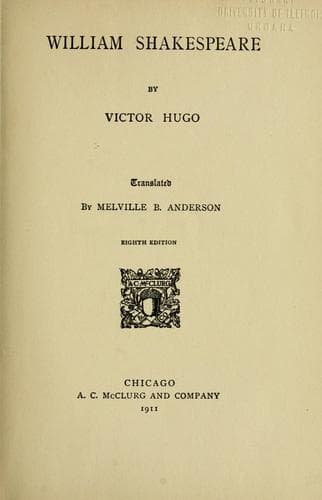
Dramatists, English -- Early modern, 1500-1700 -- Biography; Shakespeare, William, 1564-1616; Stratford-upon-Avon (England) -- Biography
des Lois" are an exact copy of the classifications in the hell of the
"Divina Commedia." That which Juvenal does for the Rome of the Cæsars,
Dante does for the Rome of popes; but Dante is a more terrible judge
than Juvenal. Juvenal whips with cutting thongs; Dante scourges with
flames. Juvenal condemns; Dante damns. Woe to the living on whom this
awful traveller fixes the unfathomable glare of his eyes!
12. Another, Rabelais, is the soul of Gaul. And who says Gaul says also
Greece, for the Attic salt and the Gallic jest have at bottom the same
flavour; and if anything, buildings apart, resembles the Piræus, it is
La Rapée. Aristophanes is distanced; Aristophanes is wicked. Rabelais
is good; Rabelais would have defended Socrates. In the order of lofty
genius, Rabelais chronologically follows Dante; after the stem face,
the sneering visage. Rabelais is the wondrous mask of ancient comedy
detached from the Greek proscenium, from bronze made flesh, henceforth
a human living face, remaining enormous, and coming among us to laugh
at us, and with us. Dante and Rabelais spring from the school of the
Franciscan friars, as later Voltaire springs from the Jesuits. Dante
the incarnate sorrow, Rabelais the parody, Voltaire the irony,--they
came from the Church against the Church. Every genius has his invention
or his discovery. Rabelais has made this one: the belly. The serpent is
in man; it is the intestines. It tempts, betrays, and punishes. Man,
single being as a spirit and complex as man, has within himself for his
earthly mission three centres,--the brain, the heart, the stomach. Each
of these centres is august by one great function which is peculiar to
it: the brain has thought, the heart has love, the belly has paternity
and maternity. The belly may be tragic. "Feri ventrem," says Agrippina.
Catherine Sforza, threatened with the death of her children, kept in
hostage, exhibits herself naked to her navel on the battlements of
the citadel of Rimini and says to the enemy, "With this I can give
birth to others." In one of the epic convulsions of Paris a woman of
the people, standing on a barricade, raised her petticoat, showed the
soldiery her naked belly, and cried, "Kill your mothers!" The soldiers
perforated that belly with balls. The belly has its heroism; but it
is from it that flows in life corruption, in art comedy. The breast,
where the heart rests, has for its summit the head; the belly has the
phallus. The belly being the centre of matter, is our gratification
and our danger; it contains appetite, satiety, and putrefaction. The
devotion, the tenderness, which we feel then are subject to death;
egotism replaces them. Easily do the affections become intestines.
That the hymn can become a drunkard's brawl, that the strophe can be
deformed into a couplet, is sad. That comes from the beast that is
in man. The belly is essentially this beast. Degradation seems to be
its law. The ladder of sensual poetry has for its topmost round the
Public-domain text, read in full here on John Shaqi.
Reviews
Reviews
No reviews yet
Be the first to share your thoughts on this work.
Join the Discussion
Join the discussion
Sign in to leave a comment or review.
Sign InorCreate an account