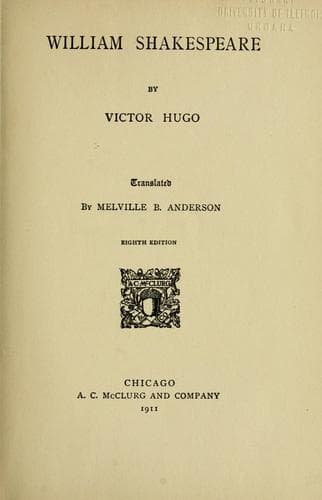
Dramatists, English -- Early modern, 1500-1700 -- Biography; Shakespeare, William, 1564-1616; Stratford-upon-Avon (England) -- Biography
Canticle of Canticles, and for its lowest the coarse jest. The belly
god is Silenus; the belly emperor is Vitellius; the belly animal is the
pig. One of those horrid Ptolemies was called the Belly,--_Physcon._
The belly is to humanity a formidable weight: it breaks every moment
the equilibrium between the soul and the body. It fills history. It is
responsible for nearly all crimes. It is the bottle of all vices. It is
the belly which by voluptuousness makes the sultan and by drunkenness
the czar; it is this that shows Tarquin the bed of Lucrece; it is
this that ends by making that senate which had waited for Brennus
and dazzled Jugurtha deliberate on the sauce of a turbot. It is the
belly which counsels the ruined libertine, Cæsar, the passage of the
Rubicon. To pass the Rubicon, how well that pays one's debts! To pass
the Rubicon, how readily that throws women, into one's arms! What good
dinners afterward! And the Roman soldiers enter Rome with the cry,
"Urbani, claudite uxores; mœchum calvum adducimus." The appetite
debauches the intellect. Voluptuousness replaces will. At starting, as
is always the case, there is some nobleness. It is the orgy. There is a
gradation between being fuddled and being dead drunk.
Then the orgy degenerates into bestial gluttony. Where there was
Solomon there is Ramponneau. Man becomes a barrel; an inner sea of dark
ideas drowns thought; conscience submerged cannot warn the drunken
soul. Beastliness is consummated; it is not even any longer cynical,
it is empty and beastly. Diogenes disappears; there remains but the
barrel. We commence by Alcibiades, we finish by Trimalcion. It is
complete; nothing more, neither dignity, nor shame, nor honour, nor
virtue, nor wit,--animal gratification in all its nakedness, thorough
impurity. Thought dissolves itself in satiety; carnal gorging absorbs
everything; nothing survives of the grand sovereign creature inhabited
by the soul. As the word goes, the belly eats the man. Such is the
final state of all societies where the ideal is eclipsed. That passes
for prosperity, and is called aggrandizing one's self. Sometimes even
philosophers thoughtlessly aid this degradation by inserting in their
doctrines the materialism which is in the consciences. This sinking
of man to the level of the human beast is a great calamity. Its first
fruit is the turpitude visible at the summit of all professions,--the
venal judge, the simoniacal priest, the hireling soldier; laws,
manners, and beliefs are a dungheap,--_totus homo fit excrementum._
In the sixteenth century all the institutions of the past are in
that state. Rabelais gets hold of that situation; he proves it; he
authenticates that belly which is the world. Civilization is, then,
but a mass; science is matter; religion is blessed with a stomach;
feudality is digesting; royalty is obese. What is Henry VIII.? A
paunch. Rome is a fat-gutted old woman. Is it health? Is it sickness?
It is perhaps obesity; it is perhaps dropsy-query.
Public-domain text, read in full here on John Shaqi.
Reviews
Reviews
No reviews yet
Be the first to share your thoughts on this work.
Join the Discussion
Join the discussion
Sign in to leave a comment or review.
Sign InorCreate an account