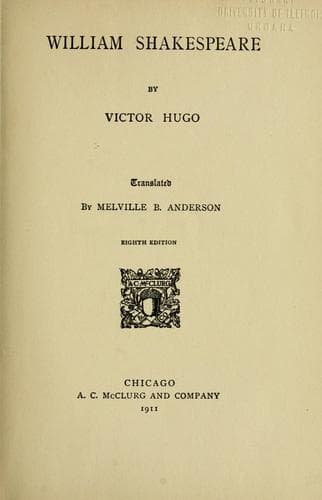
Dramatists, English -- Early modern, 1500-1700 -- Biography; Shakespeare, William, 1564-1616; Stratford-upon-Avon (England) -- Biography
It arrives like the Silenus of
Plautus; and it may also say, "I am the god mounted on an ass." Wisdom
at once, reason by-and-by; it is indeed the strange history of the
human mind. What more wise than all religions? What less reasonable?
Morals true, dogmas false. Wisdom is in Homer and in Job; reason, such
as it ought to be to overcome prejudices,--that is to say, complete
and armed _cap-à-pie_,--will be found only in Voltaire. Common-sense
is not wisdom and is not reason; it is a little of one and a little
of the other, with a dash of egotism. Cervantes makes it bestride
ignorance; and, at the same time, completing his profound satire, he
gives fatigue as a nag to heroism. Thus he shows one after the other,
one with the other, the two profiles of man, and parodies them, without
more pity for the sublime than for the grotesque. The hippogriff
becomes Rosinante. Behind the equestrian figure, Cervantes creates and
gives movement to the asinine personage. Enthusiasm takes the field,
Irony follows in its footsteps. The wonderful feats of Don Quixote,
his riding and spurring, his big lance, steady in the rest, are judged
by the donkey, a connoisseur in windmills. The invention of Cervantes
is so masterly that there is between the man type and the quadruped
complement statuary adhesion; the reasoner, like the adventurer, is
part of the beast which belongs to him, and you can no more dismount
Sancho Panza than Don Quixote. The Ideal is in Cervantes as in Dante;
but it is called the impossible, and is scoffed at. Beatrice is become
Dulcinea. To rail at the ideal would be the failing of Cervantes; but
this failing is only apparent. Look well! The smile has a tear. In
reality, Cervantes is for Don Quixote what Molière is for Alcestes.
One must learn how to read in a peculiar manner in the books of the
sixteenth century; there is in almost all, on account of the threats
hanging over the liberty of thought, a secret that must be opened, and
the key of which is often lost Rabelais had something unexpressed,
Cervantes had an aside, Machiavelli had a secret recess,--several
perhaps; at all events, the advent of common-sense is the great fact
in Cervantes. Common-sense is not a virtue; it is the eye of interest.
It would have encouraged Themistocles and dissuaded Aristides.
Leonidas has no common-sense; Regulus has no common-sense; but in the
face of egotistical and ferocious monarchies dragging poor peoples
into wars undertaken for themselves, decimating families, making
mothers desolate, and driving men to kill each other with all those
fine words,--military honour, warlike glory, obedience to discipline
etc.,--it is an admirable personification, that common-sense coming all
at once and crying to the human race, "Take care of your skin!"
Public-domain text, read in full here on John Shaqi.
Reviews
Reviews
No reviews yet
Be the first to share your thoughts on this work.
Join the Discussion
Join the discussion
Sign in to leave a comment or review.
Sign InorCreate an account