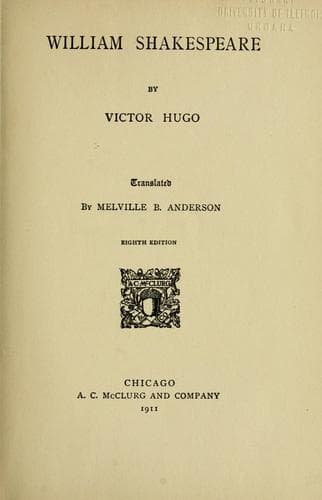
Dramatists, English -- Early modern, 1500-1700 -- Biography; Shakespeare, William, 1564-1616; Stratford-upon-Avon (England) -- Biography
14. Another, Shakespeare, what is he? You might almost answer, He is
the earth. Lucretius is the sphere; Shakespeare is the globe. There is
more and less in the globe than in the sphere. In the sphere there is
the whole; on the globe there is man. Here the outer, there the inner,
mystery. Lucretius is the being; Shakespeare is the existence. Thence
so much shadow in Lucretius; thence so much movement in Shakespeare.
Space,--_the blue_, as the Germans ay,--is certainly not forbidden
to Shakespeare. The earth sees and surveys heaven; the earth knows
heaven under its two aspects,--darkness and azure, doubt and hope. Life
goes and comes in death. All life is a secret,--a sort of enigmatical
parenthesis between birth and the death-throe, between the eye which
opens and the eye which closes. This secret imparts its restlessness to
Shakespeare. Lucretius is; Shakespeare lives. In Shakespeare the birds
sing, the bushes become verdant, the hearts love, the souls suffer,
the cloud wanders, it is hot, it is cold, night falls, time passes,
forests and crowds speak, the vast eternal dream hovers about. The sap
and the blood, all forms of the fact multiple, the actions and the
ideas, man and humanity, the living and the life, the solitudes, the
cities, the religions, the diamonds and pearls, the dung-hills and the
charnel-houses, the ebb and flow of beings, the steps of the comers and
goers,--all, all are on Shakespeare and in Shakespeare; and this genius
being the earth, the dead emerge from it. Certain sinister sides of
Shakespeare are haunted by spectres. Shakespeare is a brother of Dante.
The one completes the other. Dante incarnates all supernaturalism,
Shakespeare all Nature; and as these two regions, Nature and
supernaturalism, which appear to us so different, are really the same
unity, Dante and Shakespeare, however dissimilar, commingle outwardly,
and are but one innately. There is something of the Alighieri,
something of the ghost in Shakespeare. The skull passes from the hands
of Dante into the hands of Shakespeare. Ugolino gnaws it, Hamlet
questions it; and it shows perhaps even a deeper meaning and a loftier
teaching in the second than in the first. Shakespeare shakes it and
makes stars fall from it The isle of Prospero, the forest of Ardennes,
the heath of Armuyr, the platform of Elsinore, are not less illuminated
than the seven circles of Dante's spiral by the sombre reverberation
of hypothesis. The unknown--half fable, half truth--is outlined there
as well as here. Shakespeare as much as Dante allows us to glimpse at
the crepuscular horizon of conjecture. In the one as in the other there
is the possible,--that window of the dream opening on reality. As for
the real, we insist on it, Shakespeare overflows with it; everywhere
the living flesh. Shakespeare possesses emotion, instinct, the true
cry, the right tone, all the human multitude in his clamour. His poetry
is himself, and at the same time it is you. Like Homer, Shakespeare
Public-domain text, read in full here on John Shaqi.
Reviews
Reviews
No reviews yet
Be the first to share your thoughts on this work.
Join the Discussion
Join the discussion
Sign in to leave a comment or review.
Sign InorCreate an account