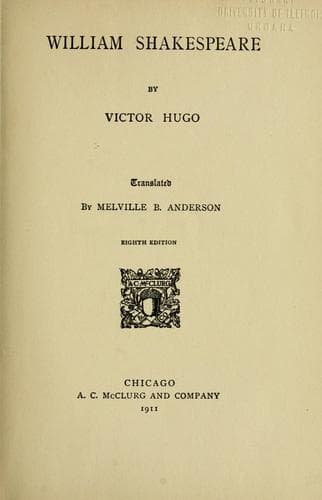
Dramatists, English -- Early modern, 1500-1700 -- Biography; Shakespeare, William, 1564-1616; Stratford-upon-Avon (England) -- Biography
Man passes before this insubmergible wreck. Enough remains for an
immense glory. What the darkness has taken adds the unknown to this
greatness. Buried and eternal, his brow projecting from the grave,
Æschylus looks at generations.
CHAPTER IV.
To the eyes of the thinker, these men of genius occupy thrones in the
ideal.
To the individual works that those men have left us, must be
added various vast collective works, the Vedas, the Râmayana, the
Mahâbhârata, the Edda, the Niebelungen, the Heldenbuch, the Romancero.
Some of these works are revealed and sacred. Unknown assistance is
marked on them. The poems of India in particular have the ominous
fulness of the possible imagined by insanity, or related by dreams.
These works seem to have been composed in common with beings to whom
our world is no longer accustomed. Legendary horror covers these epic
poems. _These books have not been composed by man alone_; the Ash-Nagar
inscription says it. Djinns have alighted upon them; polypterian magi
have thought over them; the texts have been interlined by invisible
hands; the demi-gods have been aided by demi-demons; the elephant,
which India calls the sage, has been consulted. Thence a majesty
almost horrible. The great enigmas are in these poems. They are full
of mysterious Asia. Their prominent parts have the supernatural and
hideous outline of chaos. They are a mass in the horizon like the
Himalayas. The distance of the manners, beliefs, ideas, actions,
persons, is extraordinary. One reads these poems with that wondering
stoop of the head which is induced by the profound distance that
there is between the book and the reader. This Holy Writ of Asia has
evidently been yet more difficult to reduce and put into shape than
our own. It is in every part refractory to unity. In vain have the
Brahmins, like our priests, erased and interpolated. Zoroaster is
there; Ized Serosch is there. The Eschem of the Mazdæan traditions
appears under the name of Siva; Manicheism is discernible between
Brahma and Bouddha. All kinds of traces blend, cross, and recross each
other in these poems. One may see in them the mysterious tramp of a
crowd of minds who have worked at them in the mist of ages. Here the
measureless toe of the giant; there the claw of the chimera. Those
poems are the pyramid of a vanished colony of ants.
Public-domain text, read in full here on John Shaqi.
Reviews
Reviews
No reviews yet
Be the first to share your thoughts on this work.
Join the Discussion
Join the discussion
Sign in to leave a comment or review.
Sign InorCreate an account