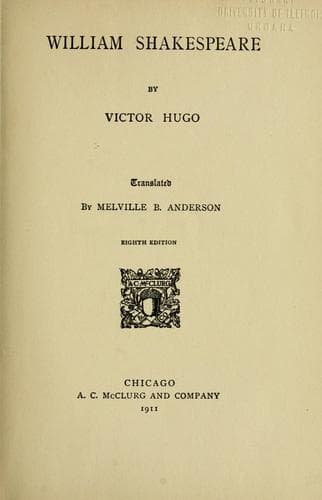
Dramatists, English -- Early modern, 1500-1700 -- Biography; Shakespeare, William, 1564-1616; Stratford-upon-Avon (England) -- Biography
is element Men of genius, re-beginners,--it is the right name for
them,--rise at all the decisive crises of humanity; they sum up the
phases and complete the revolutions. In civilization, Homer stamps
the end of Asia and the commencement of Europe; Shakespeare stamps
the end of the Middle Ages. This closing of the Middle Ages, Rabelais
and Cervantes have fixed also; but, being essentially satirists, they
give but a partial aspect Shakespeare's mind is a total; like Homer,
Shakespeare is a cyclic man. These two geniuses, Homer and Shakespeare,
close the two gates of barbarism,--the ancient door and the gothic one.
That was their mission; they have fulfilled it. That was their task;
they have accomplished it. The third great human crisis is the French
Revolution; it is the third huge gate of barbarism, the monarchical
gate, which is closing at this moment. The nineteenth century hears it
rolling on its hinges. Thence for poetry, the drama, and art arises the
actual era, as independent of Shakespeare as of Homer.
[Footnote 1: Song XVII. of the Iliad.]
[Footnote 2: Ezekiel, XLIII. 7.]
[Footnote 3: Preface to "Cromwell."]
CHAPTER III.
Homer, Job, Æschylus, Isaiah, Ezekiel, Lucretius, Juvenal, Saint John,
Saint Paul, Tacitus, Dante, Rabelais, Cervantes, Shakespeare.
That is the avenue of the immovable giants of the human mind.
The men of genius are a dynasty. Indeed there is no other. They wear
all the crowns,--even that of thorns.
Each of them represents the sum total of absolute that man can realize.
We repeat it, to choose between these men, to prefer one to the other,
to mark with the finger the first among these first, it cannot be. All
are the Mind.
Perhaps, in an extreme case--and yet every objection would be
legitimate--you might mark out as the highest summit among those
summits, Homer, Æschylus, Job, Isaiah, Dante, and Shakespeare.
It is understood that we speak here only in an Art point of view, and
in Art, in the literary point of view.
Two men in this group, Æschylus and Shakespeare, represent specially
the drama.
Æschylus, a kind of genius out of time, worthy to stamp either a
beginning or an end in humanity, does not seem to be placed in his
right turn in the series, and, as we have said, seems an elder son of
Homer's.
If we remember that Æschylus is nearly submerged by the darkness
rising over human memory; if we remember that ninety of his plays have
disappeared, that of that sublime hundred there remain no more than
seven dramas, which are also seven odes, we are stupefied by what we
see of that genius, and almost frightened by what we do not see.
What, then, was Æschylus? What proportions and what forms had he in
all this shadow? Æschylus is up to his shoulders in the ashes of ages.
His head alone remains out of that burying; and, like the giant of the
desert, with his head alone he is as immense as all the neighbouring
gods standing on their pedestals.
Public-domain text, read in full here on John Shaqi.
Reviews
Reviews
No reviews yet
Be the first to share your thoughts on this work.
Join the Discussion
Join the discussion
Sign in to leave a comment or review.
Sign InorCreate an account