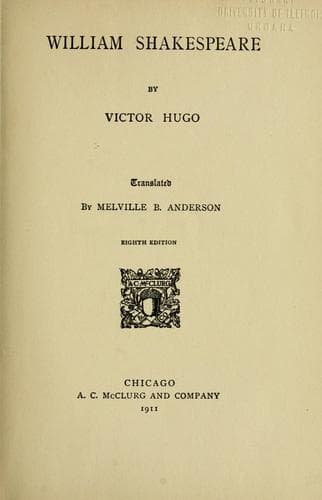
Dramatists, English -- Early modern, 1500-1700 -- Biography; Shakespeare, William, 1564-1616; Stratford-upon-Avon (England) -- Biography
Music is the Verb of Germany. The German race, so much curbed as a
people, so emancipated as thinkers, sing with a sombre love. To sing
resembles a freeing from bondage. Music expresses that which cannot
be said, and on which it is impossible to be silent. Therefore is
Germany all music until she becomes all liberty. Luther's choral is
somewhat a Marseillaise. Everywhere singing clubs and singing tables.
In Swabia every year the fête of song, on the banks of the Neckar, in
the plains of Enslingen. The _Liedermusik_, of which Schubert's "Le Roi
des Aulnes" is the _chef-d'œuvre_, is part of German life. Song is for
Germany a breathing. It is by singing that she respires and conspires.
The note being the syllable of a kind of undefined universal language,
Germany's grand communication with the human race is made through
harmony,--an admirable commencement to unity. It is by the clouds that
the rains which fertilize the earth ascend from the sea; it is by music
that the ideas which go deep into souls pass out of Germany.
Therefore we may say that Germany's greatest poets are her musicians,
of which wonderful family Beethoven is the head.
Homer is the great Pelasgian; Æschylus, the great Hellene; Isaiah,
the great Hebrew; Juvenal, the great Roman; Dante, the great Italian;
Shakespeare, the great Englishman; Beethoven, the great German.
[Footnote 1: Preface of the Burgraves, 1843.]
CHAPTER V.
The Ex-"Good Taste," that other divine law which has for so long a time
weighed on Art, and which had succeeded in suppressing the Beautiful
for the benefit of the Pretty, the ancient criticism, not altogether
dead, like the ancient monarchy, prove, from their own point of view,
the same fault, exaggeration, in those sovereign men of genius whom we
have named above. They are exaggerated.
This is caused by the quantity of the infinite that they have in them.
In fact, they are not circumscribed. They contain something unknown.
Every reproach that is addressed to them might be addressed to
sphinxes. People reproach Homer for the carnage which fills his cavern,
the Iliad; Æschylus, for his monstrousness; Job, Isaiah, Ezekiel, Saint
Paul, for double meanings; Rabelais, for obscene nudity and venomous
ambiguity; Cervantes, for insidious laughter; Shakespeare, for his
subtlety; Lucretius, Juvenal, Tacitus, for obscurity; John of Patmos
and Dante Alighieri for darkness.
None of those reproaches can be made to other minds very great, but
less great. Hesiod, Æsop, Sophocles, Euripides, Plato, Thucydides,
Anacreon, Theocritus, Titus Livius, Sallust, Cicero, Terence, Virgil,
Horace, Petrarch, Tasso, Ariosto, La Fontaine, Beaumarchais, Voltaire,
have neither exaggeration nor darkness nor obscurity nor monstrousness.
What, then, fails them? _That_ which the others have.
_That_ is the Unknown.
_That_ is the Infinite.
Public-domain text, read in full here on John Shaqi.
Reviews
Reviews
No reviews yet
Be the first to share your thoughts on this work.
Join the Discussion
Join the discussion
Sign in to leave a comment or review.
Sign InorCreate an account