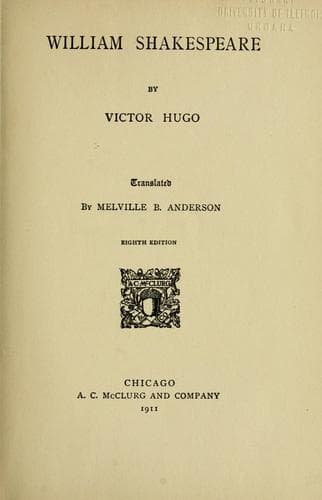
Dramatists, English -- Early modern, 1500-1700 -- Biography; Shakespeare, William, 1564-1616; Stratford-upon-Avon (England) -- Biography
Who would venture to deny this? The circle of readers enlarging, the
circle of books read will increase. Now, the want of reading being a
train of powder, once lighted it will not stop; and this, combined with
the simplification of hand-labour by machinery, and with the increased
leisure of man, the body less fatigued leaving intelligence more free,
vast appetites for thought will spring up in all brains; the insatiable
thirst for knowledge and meditation will become more and more the human
preoccupation; low places will be deserted for high places,--a natural
ascent for every growing intelligence. People will quit Faublas to read
"Orestes." There they will taste greatness; and once they have tasted
it, they will never be satiated. They will devour the beautiful because
the refinement of minds augments in proportion to their force; and a
day will come when the fulness of civilization making itself manifest,
those summits, almost desert for ages, and haunted solely by the
_élite_,--Lucretius, Dante, Shakespeare,--will be crowded with souls
seeking their nourishment on the lofty peaks.
CHAPTER II.
There can be but one law; the unity of law results from the unity
of essence. Nature and art are the two sides of the same fact;
and in principle, saving the restriction which we shall indicate
very shortly, the law of one is the law of the other. The angle of
reflection equals the angle of incidence. All being equity in the
moral order and equilibrium in the material order, all is equation
in the intellectual order. The binomial theorem, that marvel fitting
everything, is included in poetry not less than in algebra. Nature
plus humanity, raised to the second power, gives art That is the
intellectual binomial theorem. Now replace this A + B by the number
special to each great artist and each great poet, and you will have,
in its multiple physiognomy and in its strict total, each of the
creations of the human mind. What more beautiful than the variety of
_chefs-d'œuvre_ resulting from the unity of law. Poetry like science
has an abstract root; out of that science evokes the _chef-d'œuvre_ of
metal, wood, fire, or air,--machine, ship, locomotive, æroscaph; out
of that poetry evokes the _chef-d'œuvre_ of flesh and blood,--Iliad,
Canticle of Canticles, Romancero, Divine Comedy, "Macbeth." Nothing so
starts and prolongs the shock felt by the thinker as those mysterious
exfoliations of abstraction into realities in the double region, the
one positive, the other infinite, of human thought. A region double,
and nevertheless one; the infinite is a precision. The profound word
_number_ is at the base of man's thought. It is, to our intelligence,
elemental; it has a harmonious as well as a mathematical signification.
Number reveals itself to art by rhythm, which is the beating of the
heart of the Infinite. In rhythm, law of order, God is felt. A verse is
a gathering like a crowd; its feet take the cadenced step of a legion.
Public-domain text, read in full here on John Shaqi.
Reviews
Reviews
No reviews yet
Be the first to share your thoughts on this work.
Join the Discussion
Join the discussion
Sign in to leave a comment or review.
Sign InorCreate an account