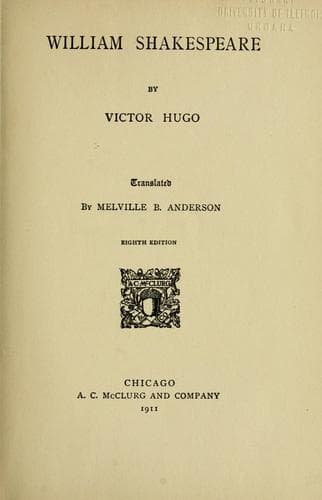
Dramatists, English -- Early modern, 1500-1700 -- Biography; Shakespeare, William, 1564-1616; Stratford-upon-Avon (England) -- Biography
Without number, no science; without number, no poetry. The strophe,
the epic poem, the drama, the riotous palpitation of man, the bursting
forth of love, the irradiation of the imagination, all this cloud with
its flashes, the passion,--all is lorded over by the mysterious word
number, even as geometry and arithmetic. Ajax, Hector, Hecuba, the
seven chiefs before Thebes, Œdipus, Ugolino, Messalina, Lear and
Priam, Romeo, Desdemona, Richard III., Pantagruel, the Cid, Alcestes,
all belong to it, as well as conic sections and the differential and
integral calculus. It starts from two and two make four, and ascends to
the region where the lightning sits.
Yet, between art and science, let us note a radical difference. Science
may be brought to perfection; art, not.
Why?
CHAPTER III.
Among human things, and inasmuch as it is a human thing, art is a
strange exception.
The beauty of everything here below lies in the power of reaching
perfection. Everything is endowed with that property. To increase, to
augment, to win strength, to march forward, to be worth more to-day
than yesterday,--that is at once glory and life. The beauty of art lies
in not being susceptible of improvement.
Let us insist on these essential ideas, already touched on in some of
the preceding pages.
A _chef-d'œuvre_ exists once for all. The first poet who arrives,
arrives at the summit. You will ascend after him, as high, not higher.
Ah, you call yourself Dante! well; but that one calls himself Homer.
Progress, goal constantly displaced, halting-place forever varying, has
a shifting horizon. Not so with the ideal.
Now, progress is the motive power of science; the ideal is the
generator of art.
Thus is explained why perfection is the characteristic of science, and
not of art.
A savant may outlustre a savant; a poet never throws a poet into the
shade.
Art progresses after its own fashion. It shifts its ground like
science; but its successive creations, containing the immutable, live,
while the admirable attempts of science, which are, and can be nothing
but combinations of the contingent, obliterate each other.
The relative is in science; the positive is in art. The _chef-d'œuvre_
of to-day will be the _chef d'œuvre_ of to-morrow. Does Shakespeare
interfere in any way with Sophocles? Does Molière take anything from
Plautus? Even when he borrows Amphitryon he does not take him from him.
Does Figaro blot out Sancho Panza? Does Cordelia suppress Antigone? No.
Poets do not climb over each other. The one is not the stepping-stone
of the other. They rise up alone, without any other lever than
themselves. They do not tread their equal under foot. Those who are
first in the field respect the old ones. They succeed, they do not
replace each other. The beautiful does not drive away the beautiful.
Neither wolves nor _chefs-d'œuvre_ devour each other.
Public-domain text, read in full here on John Shaqi.
Reviews
Reviews
No reviews yet
Be the first to share your thoughts on this work.
Join the Discussion
Join the discussion
Sign in to leave a comment or review.
Sign InorCreate an account