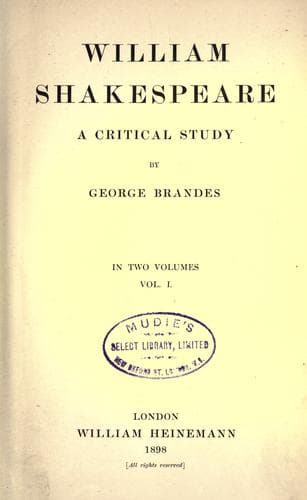
William Shakespeare: A Critical StudyBrandes, Georg
General
William Shakespeare: A Critical Study
Brandes, Georg
Shakespeare, William, 1564-1616 -- Criticism and interpretation
A letter of January 24, 1597-8, written by a certain Abraham Sturley in
Stratford to his brother-in-law, Richard Quiney, whose son afterwards
married Shakespeare's youngest daughter, shows that the poet already
passed for a man of substance, since one of his fellow-townsmen sends
him a message recommending him, instead of buying land at Shottery, to
lease part of the Stratford tithes. This would be advantageous both to
him and to the town, for the purchase of tithes was generally a good
investment, and the character of the purchaser was of importance to
the town, since a portion of the sum raised went into the municipal
treasury.[1]
It appears, however, that the purchase-money required was still beyond
Shakespeare's means, for not until seven years later, in 1605, does he
buy, for the considerable sum of £440, a moiety of the lease of the
tithes of Stratford, Old Stratford, Bishopton, and Welcombe. These
tithes originally belonged to the Church, but passed to the town in
1554, and from 1580 onwards were farmed by private persons. As might
have been expected, the purchase of them involved Shakespeare in
several lawsuits.
In a letter of 1598 or 1599, Adrian Quiney, of Stratford, writes to
his son Richard, who looked after the interests of his fellow-townsmen
in the capital: "Yff yow bargen with Wm. Sha. or receve money therfor,
brynge youre money homme that yow maye." This Richard Quiney is the
writer of the only extant letter addressed to Shakespeare (probably
never despatched), in which he begs his "loveinge contreyman," in
moving and pious terms, for a loan of £30, promising security and
interest. Another letter from Sturley, dated November 4, 1598, mentions
the news "that our countriman Mr. Wm. Shak. would procure us monei,
which I will like of as I shall heare when, and wheare, and howe."
All these documents render it sufficiently apparent that Shakespeare
did not share the loathing of interest which it was the fashion of
his day to affect, and which Antonio, in _The Merchant of Venice_,
flaunts in the face of Shylock. The taking of interest was at that time
regarded as forbidden to a Christian, but was usual nevertheless; and
Shakespeare seems to have charged the current rate, namely, ten per
cent.
During the following, years he continued to acquire still more land.
In 1602 he buys, at Stratford, arable land of the value of no less
than £320, and pays £60 for a house and a piece of ground. In 1610 he
adds twenty acres to his property. In 1612, in partnership with three
others, he buys a house and garden in London for £140.
Public-domain text, read in full here on John Shaqi.
Reviews
Reviews
No reviews yet
Be the first to share your thoughts on this work.
Elsewhere in the archive
Join the Discussion
Join the discussion
Sign in to leave a comment or review.
Sign InorCreate an account