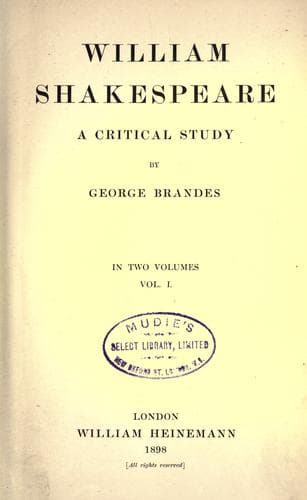
William Shakespeare: A Critical StudyBrandes, Georg
General
William Shakespeare: A Critical Study
Brandes, Georg
Shakespeare, William, 1564-1616 -- Criticism and interpretation
And Shakespeare was a strict man of business. We find him proceeding
by attorney against a poor devil named Philip Rogers of Stratford,
who in the years 1603-4 had bought small quantities of malt from him
to the total value of £1, 19s. 10d., and who had besides borrowed two
shillings of him. Six shillings he had repaid; and Shakespeare now sets
the law in motion to recover the balance of £1, 15s. 10d. In 1608-9 he
again brings an action against a Stratford debtor. This time he gets a
verdict for £6, with £1, 4s. of costs; and as the debtor has absconded,
Shakespeare proceeds against his security.
All these details show, in the first place, how closely Shakespeare
kept up his connection with Stratford during his residence in London.
By the year 1599 he has succeeded in restoring the credit of his
family. He has made his poor, debt-burdened father a gentleman with a
coat-of-arms, and has himself become one of the largest and richest
landowners in his native place. He continues steadily to increase his
capital and his property at Stratford; and it is obviously a mere
corollary to this whole course of action that he should, while still in
the full vigour of manhood, leave London, the theatre, and literature
behind him, to return to Stratford and pass his last years as a
prosperous landowner.
We next observe Shakespeare's eagerness to rise above his calling
as a player. From 1599 onwards, he had the satisfaction of being
able to write himself down: _Wm. Shakespeare of Stratford-upon-Avon
in the County of Warwick, gentleman_. But it must not, of course,
be understood that he was now in a position of equality with men
of genuinely noble birth. So little was this the case, that even
in the "Epistle Dedicatorie" to the Folio of 1623, the two actors,
his comrades, who issue the book, describe him as the "servant" of
the Earls of Pembroke and Montgomery, whose "dignity" they know to
be "greater than to descend to the reading of these trifles." They
nevertheless inscribe the "trifles" to the "incomparable paire of
brethren" out of gratitude for the great "indulgence" and "favour"
which they had "used" to the deceased poet.
The chief interest, however, of these old contracts and business
letters lies in the insight they give us into a region of Shakespeare's
soul, the existence of which, in their absence, we should never have
divined. We see that he may very well have been thinking of himself
when he makes Hamlet (v. I) say beside Ophelia's open grave: "This
fellow might be in's time a great buyer of land, with his statutes, his
recognizances, his fines, his double vouchers, his recoveries: is this
the fine of his fines, and the recovery of his recoveries, to have his
fine pate full of fine dirt?"
Public-domain text, read in full here on John Shaqi.
Reviews
Reviews
No reviews yet
Be the first to share your thoughts on this work.
Elsewhere in the archive
Join the Discussion
Join the discussion
Sign in to leave a comment or review.
Sign InorCreate an account