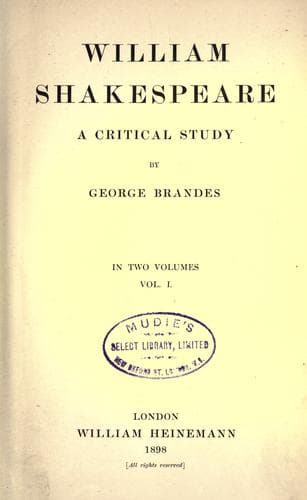
William Shakespeare: A Critical StudyBrandes, Georg
General
William Shakespeare: A Critical Study
Brandes, Georg
Shakespeare, William, 1564-1616 -- Criticism and interpretation
And--to return to our point of departure--we see that when Shakespeare,
in _The Merchant of Venice_, makes the whole play turn upon the
different relations of different men to property, position, and
wealth, the problem was one with which he was at the moment personally
preoccupied.
[1] Sturley writes:--"This is one speciall remembrance from ur
fathers motion. Itt semeth bi him that our countriman, Mr. Shaksper,
is willinge to disburse some monei upon some od yarde land or other
att Shotterie or neare about us; he thinketh it a veri fitt patterne
to move him to deale in the matter of our tithes. Bi the instruccions
u can geve him theareof, and bi the frendes he can make therefore, we
thinke it a faire marke for him to shoote att, and not unpossible to
hitt. It obtained would advance him in deede, and would do us muche
good."
XXI
_THE MERCHANT OF VENICE--ITS SOURCES--ITS CHARACTERS, ANTONIO, PORTIA,
SHYLOCK--MOONLIGHT AND MUSIC--SHAKESPEARE'S RELATION TO MUSIC_
We learn from Ben Jonson's _Volpone_ (iv. I) that the traveller who
arrived in Venice first rented apartments, and then applied to a Jew
dealer for the furniture. If the traveller happened to be a poet, he
would thus have an opportunity, which he lacked in England, of studying
the Jewish character and manner of expression. Shakespeare seems to
have availed himself of it. The names of the Jews and Jewesses who
appear in _The Merchant of Venice_ he has taken from the Old Testament.
We find in Genesis (x. 24) the name Salah (Hebrew Schelach; at that
time appearing as the name of a Maronite from Lebanon: Scialac) out
of which Shakespeare has made Shylock; and in Genesis (xi. 29) there
occurs the name Iscah (she who looks out, who spies), spelt "Jeska" in
the English translations of 1549 and 1551, out of which he made his
Jessica, the girl whom Shylock accuses of a fondness for "clambering up
to casements" and "thrusting her head into the public street" to see
the masquers pass.
Shakespeare's audiences were familiar with several versions of the
story of the Jew who relentlessly demanded the pound of flesh pledged
to him by his Christian debtor, and was at last sent empty and baffled
away, and even forced to become a Christian. The story has been found
in Buddhist legends (along with the adventure of the Three Caskets,
here interwoven with it), and many believe that it came to Europe from
India. It may, however, have migrated in just the opposite direction.
Certain it is, as one of Shakespeare's authorities points out, that the
right to take payment in the flesh of the insolvent debtor was admitted
in the Twelve Tables of ancient Rome. As a matter of fact, this antique
trait was quite international, and Shakespeare has only transferred it
from old and semi-barbarous times to the Venice of his own day.
Public-domain text, read in full here on John Shaqi.
Reviews
Reviews
No reviews yet
Be the first to share your thoughts on this work.
Elsewhere in the archive
Join the Discussion
Join the discussion
Sign in to leave a comment or review.
Sign InorCreate an account