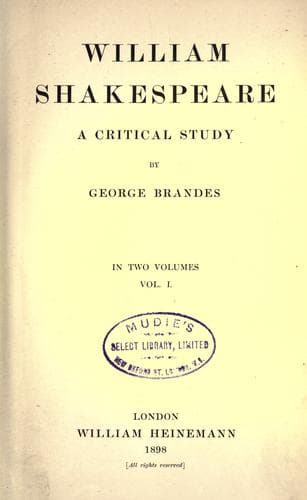
William Shakespeare: A Critical StudyBrandes, Georg
General
William Shakespeare: A Critical Study
Brandes, Georg
Shakespeare, William, 1564-1616 -- Criticism and interpretation
The story illustrates the transition from the unconditional enforcement
of strict law to the more modern principle of equity. Thus it afforded
an opening for Portia's eloquent contrast between justice and mercy,
which the public understood as an assertion of the superiority of
Christian ethics to the Jewish insistence on the letter of the law.
One of the sources on which Shakespeare drew for the figure of Shylock,
and especially for his speeches in the trial scene, is _The Orator_
of Alexander Silvayn. The 95th Declamation of this work bears the
title: "Of a Jew who would for his debt have a pound of the flesh of a
Christian." Since an English translation of Silvayn's book by Anthony
Munday appeared in 1596, and _The Merchant of Venice_ is mentioned by
Meres in 1598 as one of Shakespeare's works, there can scarcely be any
doubt that the play was produced between these dates.
In _The Orator_ both the Merchant and the Jew make speeches, and the
invective against the Jew is interesting in so far as it gives a
lively impression of the current accusations of the period against the
Israelitish race:--
"But it is no marvaile if this race be so obstinat and
cruell against us, for they doe it of set purpose to offend
our God whom they have crucified: and wherefore? Because he
was holie, as he is yet so reputed of this worthy Turkish
nation: but what shall I say? Their own bible is full of
their rebellion against God, against their Priests, Judges,
and leaders. What did not the verie Patriarks themselves,
from, whom they have their beginning? They sold their
brother...." &c.
Shakespeare's chief authority, however, for the whole play was
obviously the story of Gianetto, which occurs in the collection
entitled _Il Pecorone_, by Ser Giovanni Fiorentino, published in Milan
in 1558.
A young merchant named Gianetto comes with a richly laden ship to a
harbour near the castle of Belmonte, where dwells a lovely young widow.
She has many suitors, and is, indeed, prepared to surrender her hand
and her fortune, but only on one condition, which no one has hitherto
succeeded in fulfilling, and which is stated with mediæval simplicity
and directness. She challenges the aspirant, at nightfall, to share
her bed and make her his own; but at the same time she gives him a
sleeping-draught which plunges him in profound unconsciousness from
the moment his head touches the pillow, so that at daybreak he has
forfeited his ship and its cargo to the fair lady, and is sent on his
way, despoiled and put to shame.
Public-domain text, read in full here on John Shaqi.
Reviews
Reviews
No reviews yet
Be the first to share your thoughts on this work.
Elsewhere in the archive
Join the Discussion
Join the discussion
Sign in to leave a comment or review.
Sign InorCreate an account