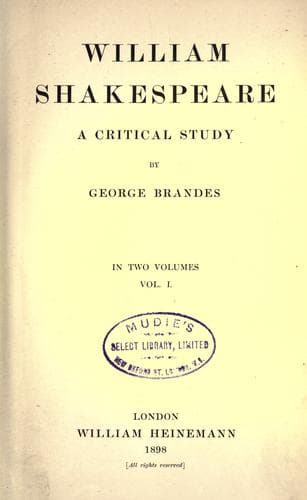
William Shakespeare: A Critical StudyBrandes, Georg
General
William Shakespeare: A Critical Study
Brandes, Georg
Shakespeare, William, 1564-1616 -- Criticism and interpretation
This misfortune happens to Gianetto; but he is so deeply in love that
he returns to Venice and induces his kind foster-father, Ansaldo, to
fit out another ship for him. But his second visit to Belmonte ends
no less disastrously, and in order to enable him to make a third
attempt his foster-father is forced to borrow 10,000 ducats from a
Jew, upon the conditions which we know. By following the advice of
a kindly-disposed waiting-woman, the young man this time escapes
the danger, becomes a happy bridegroom, and in his rapture forgets
Ansaldo's obligation to the Jew. He is not reminded of it until the
very day when it falls due, and then his wife insists that he shall
instantly start for Venice, taking with him a sum of 100,000 ducats.
She herself presently follows, dressed as an advocate, and appears in
Venice as a young lawyer of great reputation, from Bologna. The Jew
rejects every proposition for the deliverance of Ansaldo, even the
100,000 ducats. Then the trial-scene proceeds, just as in Shakespeare;
Gianetto's young wife delivers judgment, like Portia; the Jew receives
not a stiver, and dares not shed a drop of Ansaldo's blood. When
Gianetto, in his gratitude, offers the young advocate the whole 100,000
ducats, she, as in the play, demands nothing but the ring which
Gianetto has received from his wife; and the tale ends with the same
gay unravelling of the sportive complication, which gives Shakespeare
the matter for his fifth act.
Being unable to make use of the condition imposed by the fair lady of
Belmonte in _Il Pecorone_, Shakespeare cast about for another, and
found it in the _Gesta Romanorum_, in the tale of the three caskets, of
gold, silver, and lead. Here it is a young girl who makes the choice
in order to win the Emperor's son. The inscription on the golden
casket promises that whoever chooses that shall find what he deserves.
The girl rejects this out of humility, and rightly, since it proves
to contain dead men's bones. The inscription on the silver casket
promises to whoever chooses it what his nature craves. The girl rejects
that also; for, as she says naïvely, "My nature craves for fleshly
delights." Finally, the leaden casket promises that whoever chooses it
shall find what God has decreed for him; and it proves to be full of
jewels.
In Shakespeare, Portia, in accordance with her father's will, makes her
suitors choose between the three caskets (here furnished with other
legends), of which the humblest contains her portrait.
It is not probable that Shakespeare made any use of an older play, now
lost, of which Stephen Gosson, in his _School of Abuse_ (1579), says
that it represented "the greedinesse of worldly chusers, and the bloody
mindes of usurers."
The great value of _The Merchant of Venice_ lies in the depth and
seriousness which Shakespeare has imparted to the vague outlines of
character presented by the old stories, and in the ravishing moonlight
melodies which bring the drama to a close.
Public-domain text, read in full here on John Shaqi.
Reviews
Reviews
No reviews yet
Be the first to share your thoughts on this work.
Elsewhere in the archive
Join the Discussion
Join the discussion
Sign in to leave a comment or review.
Sign InorCreate an account