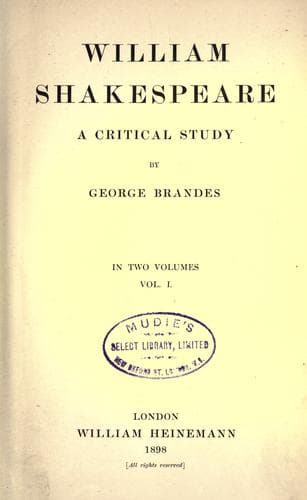
William Shakespeare: A Critical StudyBrandes, Georg
General
William Shakespeare: A Critical Study
Brandes, Georg
Shakespeare, William, 1564-1616 -- Criticism and interpretation
In Antonio, the royal merchant, who, amid all his fortune and
splendour, is a victim to melancholy and spleen induced by forebodings
of coming disaster, Shakespeare has certainly expressed something of
his own nature. Antonio's melancholy is closely related to that which,
in the years immediately following, we shall find in Jaques in _As You
Like It_, in the Duke in _Twelfth Night_, and in Hamlet. It forms a
sort of mournful undercurrent to the joy of life which at this period
is still dominant in Shakespeare's soul.--It leads, after a certain
time, to the substitution of dreaming and brooding heroes for those
men of action and resolution who, in the poet's brighter youth, had
played the leading parts in his dramas. For the rest, despite the
princely elevation of his nature, Antonio is by no means faultless. He
has insulted and baited Shylock in the most brutal fashion on account
of his faith and his blood. We realise the ferocity and violence
of the mediæval prejudice against the Jews when we find a man of
Antonio's magnanimity so entirely a slave to it. And when, with a
little more show of justice, he parades his loathing and contempt for
Shylock's money-dealings, he strangely (as it seems to us) overlooks
the fact that the Jews have been carefully excluded from all other
means of livelihood, and have been systematically allowed to scrape
together gold in order that their hoards may always be at hand when
circumstances render it convenient to plunder them. Antonio's attitude
towards Shylock cannot possibly be Shakespeare's own. Shylock cannot
understand Antonio, and characterises him (iii. 3) in the words--
"This is the fool that lent out money gratis."
But Shakespeare himself did not belong to this class of fools. He has
endowed Antonio with an ideality which he had neither the resolution
nor the desire to emulate. Such a man's conduct towards Shylock
explains the outcast's hatred and thirst for revenge.
Shakespeare has lavished peculiar and loving care upon the figure of
Portia. Both in the circumstances in which she is placed at the outset,
and in the conjuncture to which Shylock's bond gives rise, there is
a touch of the fairy tale. In so far, the two sides of the action
harmonise well with each other. Now-a-days, indeed, we are apt to
find rather too much of the nursery story in the preposterous will by
which Portia is bound to marry whoever divines the very simple answer
to a riddle--to the effect that a showy outside is not always to be
trusted. The fable of the three caskets pleased Shakespeare so much as
a means of expressing and enforcing his hatred of all empty show that
he ignored the grotesque improbability of the method of selecting a
bridegroom.
Public-domain text, read in full here on John Shaqi.
Reviews
Reviews
No reviews yet
Be the first to share your thoughts on this work.
Elsewhere in the archive
Join the Discussion
Join the discussion
Sign in to leave a comment or review.
Sign InorCreate an account