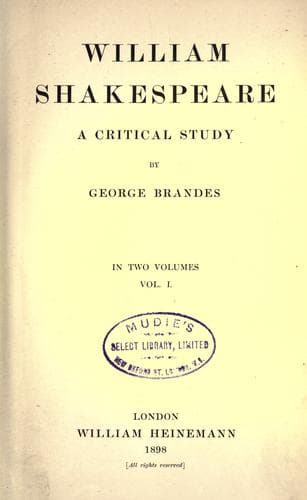
William Shakespeare: A Critical StudyBrandes, Georg
General
William Shakespeare: A Critical Study
Brandes, Georg
Shakespeare, William, 1564-1616 -- Criticism and interpretation
His thought seems to have been: Portia is not only nobly born; she
is thoroughly genuine, and can therefore be won only by a suitor who
rejects the show for the substance. This is suggested in Bassanio's
long speech before making his choice (iii. 2). If there is anything
that Shakespeare hated with a hatred somewhat disproportionate to the
triviality of the matter, a hatred which finds expression in every
stage of his career, it is the use of rouge and false hair. Therefore
he insists upon the fact that Portia's beauty owes nothing to art; with
others the case is different:--
"Look on beauty,
And you shall see 'tis purchas'd by the weight;
. . . . . . . .
So are those crisped snaky golden locks,
Which make such wanton gambols with the wind,
Upon supposed fairness, often known
To be the dowry of a second head,
The skull that bred them, in the sepulchre."
And he deduces the moral:--
"Thus ornament is but the guiled shore
To a most dangerous sea."
Before the choice, Portia dares not openly avow her feelings towards
Bassanio, but does so nevertheless by means of a graceful and sportive
slip of the tongue:--
"Beshrew your eyes,
They have o'erlook'd me, and divided me:
One half of me is yours, the other half yours,--
Mine own, I would say; but if mine, then yours,
And so all yours!"
Bassanio answers by begging permission to make instant choice between
the caskets, since he lives upon the rack until his fate is sealed;
whereupon Portia makes some remarks as to confessions on the rack,
which seem to allude to an occurrence of a few years earlier, the
barbarous execution of Elizabeth's Spanish doctor, Don Roderigo Lopez,
in 1594, after two ruffians had been racked into making confessions
which, no doubt falsely, incriminated him. Portia says jestingly--
"Ay, but I fear, you speak upon the rack,
Where men, enforced, do speak anything;"
and Bassanio answers--
"Promise me life, and I'll confess the truth."
When the choice has been made and has fallen as she hoped and desired,
her attitude clearly expresses Shakespeare's ideal of womanhood at this
period of his life. It is not Juliet's passionate self-abandonment, but
the perfect surrender in tenderness of the wise and delicate woman. For
her own sake she does not wish herself better than she is, but for him
"she would be trebled twenty times herself." She knows that she--
"Is an unlesson'd girl, unschool'd, unpractis'd:
Happy in this, she is not yet so old
But she may learn; happier than this,
She is not bred so dull but she can learn;
Happiest of all is, that her gentle spirit
Commits itself to yours to be directed,
As from her lord, her governor, her king."
Public-domain text, read in full here on John Shaqi.
Reviews
Reviews
No reviews yet
Be the first to share your thoughts on this work.
Elsewhere in the archive
Join the Discussion
Join the discussion
Sign in to leave a comment or review.
Sign InorCreate an account