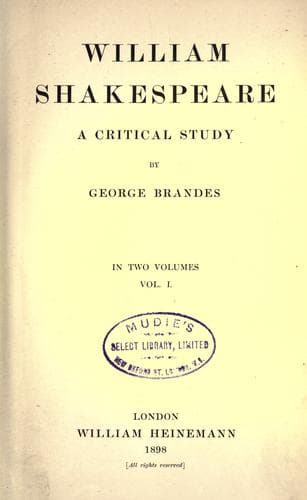
William Shakespeare: A Critical StudyBrandes, Georg
General
William Shakespeare: A Critical Study
Brandes, Georg
Shakespeare, William, 1564-1616 -- Criticism and interpretation
In such humility does she love this weak spendthrift; whose sole motive
in seeking her out was originally that of clearing off the debts in
which his frivolity had involved him. It thus happens, quaintly enough,
that what her father thought to prevent by his strange device, namely,
that Portia should be won by a mercenary suitor, is the very thing that
happens--though it is true that her personal charms throw his original
motive into the background.
In spite of Portia's womanly self-surrender in love, there is something
independent, almost masculine, in her character. She has the orphan
heiress's habit and power of looking after herself, directing others,
and acting on her own responsibility without seeking advice or taking
account of convention. The poet has borrowed traits from the Italian
novel in order to make her as prompt in counsel as she is magnanimous.
How much money does Antonio owe? she asks. Three thousand ducats? Give
the Jew six thousand, and tear up the bond.
Shakespeare has equipped her with the bright and victorious temperament
with which he henceforth, for a certain time, endows nearly all the
heroines of his comedies. To another of these ladies it is said,
"Without question, you were born in a merry hour." She answers, "No,
sure, my lord, my mother cried; but then there was a star danced, and
under that I was born." All these young women were born under a star
that danced. Even the most subdued of them overflows with the rapture
of existence.
Portia's nature is health, its utterance joy. Radiant happiness is
her element. She is descended from happiness, she has grown up in
happiness, she is surrounded with all the means and conditions of
happiness, and she distributes happiness with both hands. She is noble
to the heart's core. She is no swan born in the duck-yard, but is in
complete harmony with her surroundings and with herself.
Public-domain text, read in full here on John Shaqi.
Reviews
Reviews
No reviews yet
Be the first to share your thoughts on this work.
Elsewhere in the archive
Join the Discussion
Join the discussion
Sign in to leave a comment or review.
Sign InorCreate an account