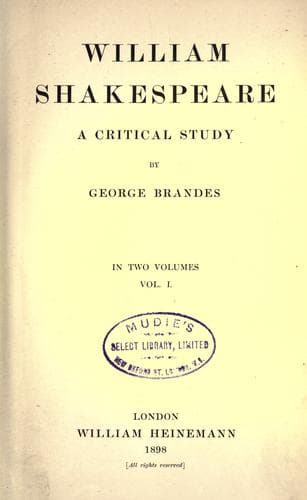
William Shakespeare: A Critical StudyBrandes, Georg
General
William Shakespeare: A Critical Study
Brandes, Georg
Shakespeare, William, 1564-1616 -- Criticism and interpretation
Shylock's riches consist of gold and jewels, easy to conceal or to
transport at a moment's notice, but also inviting to robbery and
rapine. Antonio's riches consist in cargoes tossed on many seas, and
exposed to danger from storms and from pirates. What Portia owns she
owns in security: estates and palaces inherited from her fathers. There
has needed, perhaps, as much as a century of direct preparation for
the birth of such a creature. Her noble forefathers for generations
back must have led free and stainless lives, favoured by destiny,
prosperous and happy, in order to amass the riches which are her
pedestal, to gain the respect which is her throne, to gather the
household which forms her retinue, to decorate the palace in which she
rules as a princess, and to endow her mind with the high faculty and
culture befitting a reigning sovereign. She is healthy, though she is
delicate; she is gay, although she is mentally a head taller than any
of those around her; and she is young, although she is wise. She is of
a fresher stock than the nervous women of to-day. She is borne aloft
by an unfailing serenity of nature, which has never suffered any rude
disturbance. It manifests itself in her gaiety under circumstances of
painful uncertainty, in her self-control in overwhelming joy, and in
her promptitude of action in an unforeseen and threatening conjuncture.
She has inexhaustible resources in her soul, a profusion of ideas
and inspirations, as great a super-abundance of wit as of wealth. In
contradistinction to her lover, she never makes a display of what is
not her own to command. Hence her equilibrium and queenly repose. If
we do not realise this radiant joy of life in the inmost chambers of
her soul, we are apt, even from her first scene with Nerissa, to think
her jesting forced and her wit far-fetched, and are almost ready to
make the criticism that only a poor intelligence plays tricks with
speech and fantasticates in words. But when we have looked into the
depths of this well-spring of health, we understand how her thoughts
gush forth, flashing and plashing, as freely and inevitably as the jets
of a fountain rise into the air. She evokes and discards image after
image, as one plucks and throws away flowers in a luxuriant garden. She
delights to wreath and plait her words, as she wreaths and plaits her
hair.
It harmonises with her whole nature when she says (i. 2): "The brain
may devise laws for the blood; but a hot temper leaps o'er a cold
decree: such a hare is madness, the youth, to skip o'er the meshes of
good counsel, the cripple." Such phrases must be conceived as springing
from a delight in laughter and sport for the sport's sake; otherwise
they would be stiff and cumbrous. In the same way, such a sally as this
(iv. I)--
"Your wife would give you little thanks for that,
If she were by to hear you make the offer,"
Public-domain text, read in full here on John Shaqi.
Reviews
Reviews
No reviews yet
Be the first to share your thoughts on this work.
Elsewhere in the archive
Join the Discussion
Join the discussion
Sign in to leave a comment or review.
Sign InorCreate an account