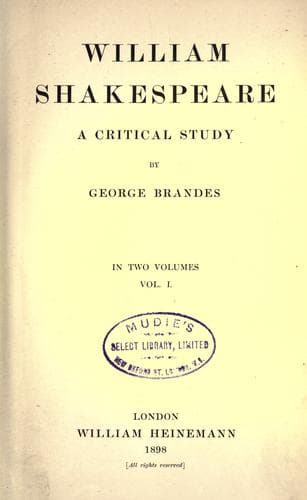
William Shakespeare: A Critical StudyBrandes, Georg
General
William Shakespeare: A Critical Study
Brandes, Georg
Shakespeare, William, 1564-1616 -- Criticism and interpretation
must be taken as springing from a gleeful assurance of victory, else
it might seem to show callous indifference to Antonio's apparently
hopeless plight. There is an innate harmony in Portia's soul; but it is
full-toned, complex, and woven of strongly contrasted elements, so that
it requires some imagination to represent it to ourselves. There is
something in the harmonious subtlety of her physiognomy which reminds
us of Leonardo's female heads. Dignity and tenderness, the power to
command and to obey, acuteness such as thrives in courts, and simple
womanliness, an almost inflexible seriousness and an almost mischievous
gaiety, are here cunningly commingled and combined.
How Shakespeare himself would have us regard her may be gathered from
the enthusiasm with which he makes Jessica describe her to her lover
(iii. 5). When one young woman so warmly eulogises another, we may
safely assume that her merits are unimpeachable. "It is very meet," she
says,
"The Lord Bassanio live an upright life,
For, having such a blessing in his lady,
He finds the joys of heaven here on earth;
And, if on earth he do not mean it, then
In reason he should never come to heaven.
Why, if two gods should play some heavenly match,
And on the wager lay two earthly women,
And Portia one, there must be something else
Pawn'd with the other, for the poor rude world
Hath not her fellow."
The central figure of the play, however, in the eyes of modern readers
and spectators, is of course Shylock, though there can be no doubt
that he appeared to Shakespeare's contemporaries a comic personage,
and, since he makes his final exit before the last act, by no means
the protagonist. In the humaner view of a later age, Shylock appears
as a half-pathetic creation, a scapegoat, a victim; to the Elizabethan
public, with his rapacity and his miserliness, his usury and his
eagerness to dig for another the pit into which he himself falls,
he seemed, not terrible, but ludicrous. They did not even take him
seriously enough to feel any real uneasiness as to Antonio's fate,
since they all knew beforehand the issue of the adventure. They
laughed when he went to Bassanio's feast "in hate, to feed upon the
prodigal Christian;" they laughed when, in the scene with Tubal, he
suffered himself to be bandied about between exultation over Antonio's
misfortunes and rage over the prodigality of his runaway daughter; and
they found him odious when he exclaimed, "I would my daughter were
dead at my foot and the jewels in her ear!" He was, simply as a Jew,
a despised creature; he belonged to the race which had crucified God
himself; and he was doubly despised as an extortionate usurer. For the
rest, the English public--like the Norwegian public so lately as the
first half of this century--had no acquaintance with Jews except in
books and on the stage. From 1290 until the middle of the seventeenth
century the Jews were entirely excluded from England.
Public-domain text, read in full here on John Shaqi.
Reviews
Reviews
No reviews yet
Be the first to share your thoughts on this work.
Elsewhere in the archive
Join the Discussion
Join the discussion
Sign in to leave a comment or review.
Sign InorCreate an account