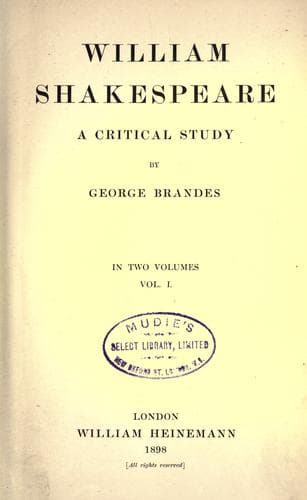
William Shakespeare: A Critical StudyBrandes, Georg
General
William Shakespeare: A Critical Study
Brandes, Georg
Shakespeare, William, 1564-1616 -- Criticism and interpretation
Every prejudice
against them was free to flourish unchecked.
Did Shakespeare in a certain measure share these religious prejudices,
as he seems to have shared the patriotic prejudices against the Maid
of Orleans, if, indeed, he is responsible for the part she plays in
_Henry VI._? We may be sure that he was very slightly affected by them,
if at all. Had he made a more undisguised effort to place himself at
Shylock's standpoint, the censorship, on the one hand, would have
intervened, while, on the other hand, the public would have been
bewildered and alienated. It is quite in the spirit of the age that
Shylock should suffer the punishment which befalls him. To pay him out
for his stiff-necked vengefulness, he is mulcted not only of the sum he
lent Antonio, but of half his fortune, and is finally, like Marlowe's
_Jew of Malta_, compelled to change his religion. The latter detail
gives something of a shock to the modern reader. But the respect for
personal conviction, when it conflicted with orthodoxy, did not exist
in Shakespeare's time. It was not very long since Jews had been forced
to choose between kissing the crucifix and mounting the faggots; and
in Strasburg, in 1349, nine hundred of them had in one day chosen the
latter alternative. It is strange to reflect, too, that just at the
time when, on the English stage, one Mediterranean Jew was poisoning
his daughter, and another whetting his knife to cut his debtor's
flesh, thousands of heroic and enthusiastic Hebrews in Spain and
Portugal, who, after the expulsion of the 300,000 at the beginning of
the century, had secretly remained faithful to Judaism, were suffering
themselves to be tortured, flayed, and burnt alive by the Inquisition,
rather than forswear the religion of their race.
It is the high-minded Antonio himself who proposes that Shylock shall
be forced to become a Christian. This is done for his good; for
baptism opens to him the possibility of salvation after death; and his
Christian antagonists, who, by dint of the most childish sophisms,
have despoiled him of his goods and forced him to forswear his God,
can still pose as representing the Christian principle of mercy, in
opposition to one who has taken his stand upon the Jewish basis of
formal law.
That Shakespeare himself, however, in nowise shared the fanatical
belief that a Jew was of necessity damned, or could be saved by
compulsory conversion, is rendered clear enough for the modern reader
in the scene between Launcelot and Jessica (iii. 5), where Launcelot
jestingly avers that Jessica is damned. There is only one hope for her,
and that is, that her father may not be her father:--
"_Jessica_. That were a kind of bastard hope, indeed: so the
sins of my mother should be visited upon me.
"_Launcelot_. Truly then I fear you are damned both by
father and mother: thus when I shun Scylla, your father, I
fall into Charybdis, your mother. Well, you are gone both
ways.
Public-domain text, read in full here on John Shaqi.
Reviews
Reviews
No reviews yet
Be the first to share your thoughts on this work.
Elsewhere in the archive
Join the Discussion
Join the discussion
Sign in to leave a comment or review.
Sign InorCreate an account