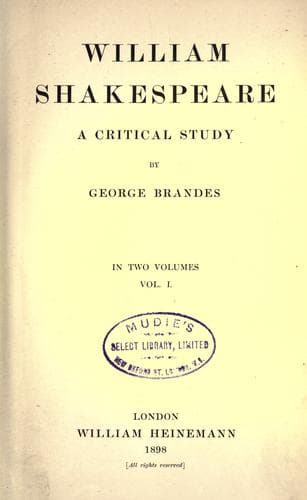
William Shakespeare: A Critical StudyBrandes, Georg
General
William Shakespeare: A Critical Study
Brandes, Georg
Shakespeare, William, 1564-1616 -- Criticism and interpretation
"_Jes_. I shall be saved by my husband; he hath made me a
Christian.
"_Laun_. Truly, the more to blame he: we were Christians
enow before; e'en as many as could well live one by another.
This making of Christians will raise the price of hogs: if
we grow all to be pork-eaters, we shall not shortly have a
rasher on the coals for money."
And Jessica repeats Launcelot's saying to Lorenzo:--
"He tells me flatly, there is no mercy for me in heaven,
because I am a Jew's daughter: and he says, you are no good
member of the commonwealth, for, in converting Jews to
Christians, you raise the price of pork."
No believer would ever speak in this jesting tone of matters that must
seem to him so momentous.
It is none the less astounding how much right in wrong, how much
humanity in inhumanity, Shakespeare has succeeded in imparting to
Shylock. The spectator sees clearly that, with the treatment he has
suffered, he could not but become what he is. Shakespeare has rejected
the notion of the atheistically-minded Marlowe, that the Jew hates
Christianity and despises Christians as fiercer money-grubbers than
himself. With his calm humanity, Shakespeare makes Shylock's hardness
and cruelty result at once from his passionate nature and his abnormal
position; so that, in spite of everything, he has come to appear in the
eyes of later times as a sort of tragic symbol of the degradation and
vengefulness of an oppressed race.
There is not in all Shakespeare a greater example of trenchant and
incontrovertible eloquence than Shylock's famous speech (iii. I):--
"I am a Jew. Hath not a Jew eyes? hath not a Jew hands,
organs, dimensions, senses, affections, passions? fed with
the same food, hurt with the same weapons, subject to the
same diseases, healed by the same means, warmed and cooled
by the same winter and summer, as a Christian is? If you
prick us, do we not bleed? if you tickle us, do we not
laugh? if you poison us, do we not die? and if you wrong us,
shall we not revenge? If we are like you in the rest, we
will resemble you in that. If a Jew wrong a Christian, what
is his humility? revenge. If a Christian wrong a Jew, what
should his sufferance be by Christian example? why, revenge.
The villany you teach me, I will execute; and it shall go
hard but I will better the instruction."
Public-domain text, read in full here on John Shaqi.
Reviews
Reviews
No reviews yet
Be the first to share your thoughts on this work.
Elsewhere in the archive
Join the Discussion
Join the discussion
Sign in to leave a comment or review.
Sign InorCreate an account