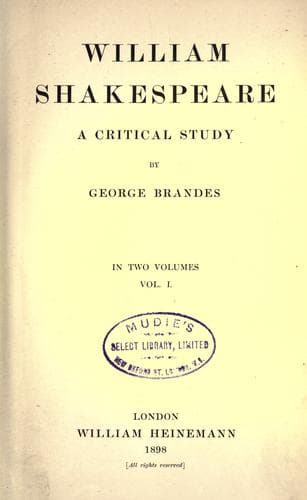
William Shakespeare: A Critical StudyBrandes, Georg
General
William Shakespeare: A Critical Study
Brandes, Georg
Shakespeare, William, 1564-1616 -- Criticism and interpretation
But what is most surprising, doubtless, is the instinct of genius
with which Shakespeare has seized upon and reproduced racial
characteristics, and emphasised what is peculiarly Jewish in Shylock's
culture. While Marlowe, according to his custom, made his Barabas
revel in mythological similes, Shakespeare indicates that Shylock's
culture is founded entirely upon the Old Testament, and makes commerce
his only point of contact with the civilisation of later times. All
his parallels are drawn from the Patriarchs and the Prophets. With
what unction he speaks when he justifies himself by the example of
Jacob! His own race is always "our sacred nation," and he feels that
"the curse has never fallen upon it" until his daughter fled with
his treasures. Jewish, too, is Shylock's respect for, and obstinate
insistence on, the letter of the law, his reliance upon statutory
rights, which are, indeed, the only rights society allows him, and the
partly instinctive, partly defiant restriction of his moral ideas to
the principle of retribution. He is no wild animal; he is no heathen
who simply gives the rein to his natural instincts; his hatred is not
ungoverned; he restrains it within its legal rights, like a tiger in
its cage. He is entirely lacking, indeed, in the freedom and serenity,
the easy-going, light-hearted carelessness which characterises a
ruling caste in its virtues and its vices, in its charities as in its
prodigalities; but he has not a single twinge of conscience about
anything that he does; his actions are in perfect harmony with his
ideals.
Sundered from the regions, the social forms, the language, in which his
spirit is at home, he has yet retained his Oriental character. Passion
is the kernel of his nature. It is his passion that has enriched him;
he is passionate in action, in calculation, in sensation, in hatred,
in revenge, in everything. His vengefulness is many times greater
than his rapacity. Avaricious though he be, money is nothing to him
in comparison with revenge. It is not until he is exasperated by his
daughter's robbery and flight that he takes such hard measures against
Antonio, and refuses to accept three times the amount of the loan. His
conception of honour may be unchivalrous enough, but, such as it is,
his honour is not to be bought for money. His hatred of Antonio is far
more intense than his love for his jewels; and it is this passionate
hatred, not avarice, that makes him the monster he becomes.
Public-domain text, read in full here on John Shaqi.
Reviews
Reviews
No reviews yet
Be the first to share your thoughts on this work.
Elsewhere in the archive
Join the Discussion
Join the discussion
Sign in to leave a comment or review.
Sign InorCreate an account