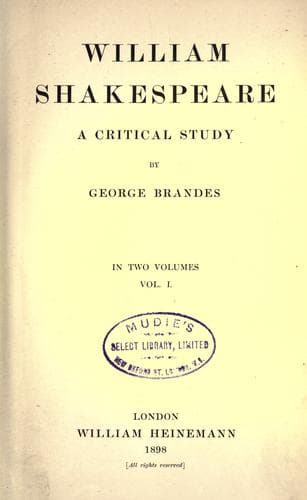
William Shakespeare: A Critical StudyBrandes, Georg
General
William Shakespeare: A Critical Study
Brandes, Georg
Shakespeare, William, 1564-1616 -- Criticism and interpretation
From this Hebrew passionateness, which can be traced even in details
of diction, arises, among other things, his loathing of sloth and
idleness. To realise how essentially Jewish is this trait we need
only refer to the so-called Proverbs of Solomon. Shylock dismisses
Launcelot with the words, "Drones hive not with me." Oriental, rather
than specially Jewish, are the images in which he gives his passion
utterance, approaching, as they so often do, to the parable form.
(See, for example, his appeal to Jacob's cunning, or the speech in
vindication of his claim, which begins, "You have among you many a
purchased slave.") Specially Jewish, on the other hand, is the way in
which this ardent passion throughout employs its images and parables
in the service of a curiously sober rationalism, so that a sharp and
biting logic, which retorts every accusation with interest, is always
the controlling force. This sober logic, moreover, never lacks dramatic
impetus. Shylock's course of thought perpetually takes the form of
question and answer, a subordinate but characteristic trait which
appears in the style of the Old Testament, and reappears to this day in
representations of primitive Jews. One can feel through his words that
there is a chanting quality in his voice; his movements are rapid, his
gestures large. Externally and internally, to the inmost fibre of his
being, he is a type of his race in its degradation.
Shylock disappears with the end of the fourth act in order that no
discord may mar the harmony of the concluding scenes. By means of his
fifth act, Shakespeare dissipates any preponderance of pain and gloom
in the general impression of the play.
This act is a moonlit landscape thrilled with music. It is altogether
given over to music and moonshine. It is an image of Shakespeare's
soul at that point of time. Everything is here reconciled, assuaged,
silvered over, and borne aloft upon the wings of music.
The speeches melt into each other like voices in part-singing:--
"_Lorenzo_. The moon shines bright.--In such a night as this,
When the sweet wind did gently kiss the trees,
And they did make no noise, in such a night,
Troilus, methinks, mounted the Trojan walls,
And sigh'd his soul toward the Grecian tents,
Where Cressid lay that night.
_Jessica_. In such a night
Did Thisbe fearfully o'ertrip the dew;
. . . . . . . .
_Lor_.
In such a night
Stood Dido with a willow in her hand;"
and so on for four more speeches--the very poetry of moonlight arranged
in antiphonies.
Public-domain text, read in full here on John Shaqi.
Reviews
Reviews
No reviews yet
Be the first to share your thoughts on this work.
Elsewhere in the archive
Join the Discussion
Join the discussion
Sign in to leave a comment or review.
Sign InorCreate an account