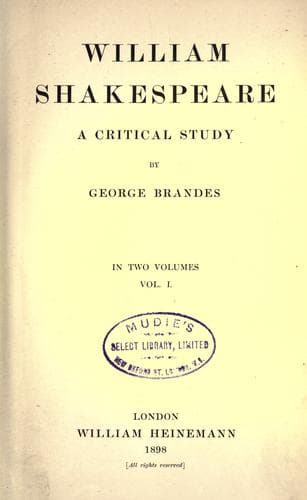
William Shakespeare: A Critical StudyBrandes, Georg
General
William Shakespeare: A Critical Study
Brandes, Georg
Shakespeare, William, 1564-1616 -- Criticism and interpretation
The conclusion of _The Merchant of Venice_ brings us to the threshold
of a term in Shakespeare's life instinct with high-pitched gaiety
and gladness. In this, his brightest period, he fervently celebrates
strength and wisdom in man, intellect and wit in woman; and these most
brilliant years of his life are also the most musical. His poetry, his
whole existence, seem now to be given over to music, to harmony.
He had been early familiar with the art of music, and must have heard
much music in his youth.[1] Even in his earliest plays, such as _The
Two Gentlemen of Verona_, we find a considerable insight into musical
technique, as in the conversation between Julia and Lucetta (i. 2). He
must often have heard the Queen's choir, and the choirs maintained by
noble lords and ladies, like that which Portia has in her palace. And
he no doubt heard much music performed in private. The English were
in his day, what they have never been since, a musical people. It was
the Puritans who cast out music from the daily life of England. The
spinet was the favourite instrument of the time. Spinets stood in the
barbers' shops, for the use of customers waiting their turn. Elizabeth
herself played on the spinet and the lute. In his Sonnet cxxviii.,
addressed to the lady whom he caressingly calls "my music," Shakespeare
has described himself as standing beside his mistress's spinet and
envying the keys which could kiss her fingers. In all probability
he was personally acquainted with John Dowland, the chief English
musician of the time, although the poem in which he is named, published
as Shakespeare's in _The Passionate Pilgrim_, is not by him, but by
Richard Barnfield.
In _The Taming of the Shrew_ (iii. I); written just before _The
Merchant of Venice_, he had utilised his knowledge of singing and
lute-playing in a scene of gay comedy. "The cause why music was
ordained," says Lucentio--
"Was it not to refresh the mind of man,
After his studies, or his usual pain?"
Its influence upon mental disease was also known to Shakespeare, and
noted both in _King Lear_ and in _The Tempest_. But here, in _The
Merchant of Venice_, where music is wedded to moonlight, his praise of
it takes a higher flight:--
"How sweet the moonlight sleeps upon this bank!
Here we will sit, and let the sounds of music
Creep in our ears: soft stillness, and the night,
Become the touches of sweet harmony."
And Shakespeare, who never mentions church music, which seems to have
had no message for his soul, here makes the usually unimpassioned
Lorenzo launch out into genuine Renaissance rhapsodies upon the music
of the spheres:--
Public-domain text, read in full here on John Shaqi.
Reviews
Reviews
No reviews yet
Be the first to share your thoughts on this work.
Elsewhere in the archive
Join the Discussion
Join the discussion
Sign in to leave a comment or review.
Sign InorCreate an account