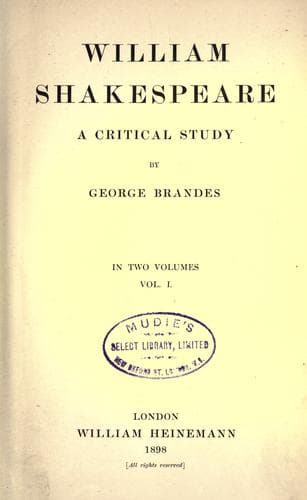
William Shakespeare: A Critical StudyBrandes, Georg
General
William Shakespeare: A Critical Study
Brandes, Georg
Shakespeare, William, 1564-1616 -- Criticism and interpretation
"Sit, Jessica: look, how the floor of heaven
Is thick inlaid with patines of bright gold.
There's not the smallest orb, which thou behold'st,
But in his motion like an angel sings,
Still quiring to the young-ey'd cherubins;
Such harmony is in immortal souls;
But, whilst this muddy vesture of decay
Doth grossly close it in, we cannot hear it."
Sphere-harmony and soul-harmony, not bell-ringing or psalm-singing, are
for him the highest music.
Shakespeare's love of music, so incomparably expressed in the last
scenes of _The Merchant of Venice_, appears at other points in the
play. Thus Portia says, when Bassanio is about to make his choice
between the caskets (iii. 2):--
"Let music sound, while he doth make his choice;
Then, if he lose, he makes a swan-like end,
Fading in music.
. . . . . . . .
He may win;
And what is music then? then music is
Even as the flourish when true subjects bow
To a new-crowned monarch."
It seems as though Shakespeare, in this play, had set himself to reveal
for the first time how deeply his whole nature was penetrated with
musical feeling. He places in the mouth of the frivolous Jessica these
profound words, "I am never merry when I hear sweet music." And he
makes Lorenzo answer, "The reason is, your spirits are attentive." The
note of the trumpet, he says, will calm a wanton herd of "unhandled
colts;" and Orpheus, as poets feign, drew trees and stones and floods
to follow him:--
"Since nought so stockish, hard, and full of rage,
But music for the time doth change his nature.
The man that hath no music in himself,
Nor is not mov'd with concord of sweet sounds,
Is fit for treasons, stratagems, and spoils;
The motions of his spirit are dull as night,
And his affections dark as Erebus.
Let no such man be trusted.--Mark the music."
This must not, of course, be taken too literally. But note the
characters whom Shakespeare makes specially unmusical: in this play,
Shylock, who loathes "the vile squeaking of the wry-necked fife;"
then Hotspur, the hero-barbarian; Benedick, the would-be woman-hater;
Cassius, the fanatic politician; Othello, the half-civilised African;
and finally creatures like Caliban, who are nevertheless enthralled by
music as though by a wizard's spell.
On the other hand, all his more delicate creations are musical. In the
First Part of _Henry IV_. (iii. I) we have Mortimer and his Welsh wife,
who do not understand each other's speech:--
"But I will never be a truant, love,
Till I have learn'd thy language; for thy tongue
Makes Welsh as sweet as ditties highly penn'd,
Sung by a fair queen in a summer's bower,
With ravishing division, to her lute."
Public-domain text, read in full here on John Shaqi.
Reviews
Reviews
No reviews yet
Be the first to share your thoughts on this work.
Elsewhere in the archive
Join the Discussion
Join the discussion
Sign in to leave a comment or review.
Sign InorCreate an account