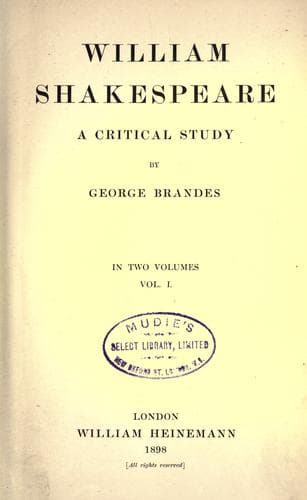
William Shakespeare: A Critical StudyBrandes, Georg
General
William Shakespeare: A Critical Study
Brandes, Georg
Shakespeare, William, 1564-1616 -- Criticism and interpretation
Musical, too, are the pathetic heroines, such as Ophelia and Desdemona,
and characters like Jaques in _As You Like It_, and the Duke and
Viola in _Twelfth Night_. The last-named comedy, indeed, is entirely
interpenetrated with music. The keynote of musical passion is struck in
the opening speech:--
"If music be the food of love, play on;
Give me excess of it, that, surfeiting,
The appetite may sicken, and so die.--
That strain again! it had a dying fall:
O! it came o'er my ear like the sweet south
That breathes upon a bank of violets,
Stealing and giving odour."
Here, too, Shakespeare's love of the folk-song finds expression, when
he makes the Duke say (ii. 4):--
"Now, good Cesario, but that piece of song,
That old and antique song, we heard last night;
Methought, it did relieve my passion much,
More than light airs, and recollected terms,
Of these most brisk and giddy-paced times:
Come; but one verse."
No less sensitive and devoted to music than the Duke in _Twelfth Night_
or Lorenzo in _The Merchant of Venice_ must their creator himself have
been in the short and happy interval in which, as yet unmastered by the
melancholy latent in his as in all deep natures, he felt his talents
strengthening and unfolding, his life every day growing fuller and
more significant, his inmost soul quickening with creative impulse and
instinct with harmony. The rich concords which bring _The Merchant of
Venice_ to a close symbolise, as it were, the feeling of inward wealth
and equipoise to which he had now attained.
[1] Förster: _Shakespeare und die Tonkunst, Shakespeare-Jahrbuch_, ii.
155; Karl Elze: _William Shakespeare_, p. 474; Henrik Schück: _William
Shakespere_ p. 313.
XXII
"_EDWARD III." AND "ARDEN OF FEVERSHAM"--SHAKESPEARE'S DICTION--THE
FIRST PART OF "HENRY IV."--FIRST INTRODUCTION OF HIS OWN EXPERIENCES
OF LIFE IN THE HISTORIC DRAMA--WHY THE SUBJECT APPEALED TO HIM--TAVERN
LIFE--SHAKESPEARE'S CIRCLE--SIR JOHN FALSTAFF--FALSTAFF AND THE
GRACIOSO OF THE SPANISH DRAMA--RABELAIS AND SHAKESPEARE--PANURGE AND
FALSTAFF_
There is extant a historical play, dating from 1596, entitled _The
Raigne of King Edward third. As it hath bin sundrie times plaied about
the Citie of London_, which several English students and critics,
among them Halliwell-Phillips, have attributed in part to Shakespeare,
arguing that the better scenes, at least, must have been carefully
retouched by him. Although the drama, as a whole, is not much more
Shakespearean in style than many other Elizabethan plays, and although
Swinburne, the highest of all English authorities, has declared the
piece to be the work of an imitator of Marlowe, yet there is a good
deal to be said in favour of the hypothesis that Shakespeare had some
hand in _Edward III_. His touch may be recognised in several passages;
and especially noteworthy are the following lines from a speech of
Warwick's:--
Public-domain text, read in full here on John Shaqi.
Reviews
Reviews
No reviews yet
Be the first to share your thoughts on this work.
Elsewhere in the archive
Join the Discussion
Join the discussion
Sign in to leave a comment or review.
Sign InorCreate an account