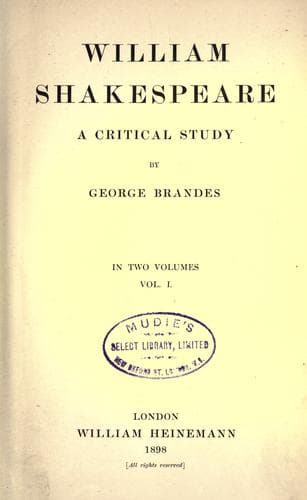
William Shakespeare: A Critical StudyBrandes, Georg
General
William Shakespeare: A Critical Study
Brandes, Georg
Shakespeare, William, 1564-1616 -- Criticism and interpretation
"A spacious field of reasons could I urge
Between his glory, daughter, and thy shame:
That poison shows worst in a golden cup;
Dark night seems darker by the lightning flash;
_Lilies that fester smell far worse than weeds,_
And every glory that inclines to sin,
The shame is treble by the opposite."
The italicised verse reappears as the last line of Shakespeare's Sonnet
xciv.; and as this Sonnet seems to refer (as we shall afterwards see)
to circumstances in Shakespeare's life which did not arise until 1600,
we cannot suppose that it was one of those written at an earlier date
and circulated in manuscript. The probability is that Shakespeare
simply reclaimed this line from a speech contributed by him to another
man's play.
It is natural that a foreign student should shrink from opposing his
judgment to that of English critics, where English diction and style
are in question. Nevertheless he is sometimes driven into dissent with
regard to the many Elizabethan plays which now one critic, and now
another, has attributed wholly or in part to Shakespeare. Take, for
instance, _Arden of Feversham,_ certainly one of the most admirable
plays of that rich period, whose merit impresses one even when one
reads it for the first time in uncritical youth. Swinburne writes of it
(_Study of Shakespeare_, p. 141):--
"I cannot but finally take heart to say, even in the absence
of all external or traditional testimony, that it seems to
me not pardonable merely nor permissible, but simply logical
and reasonable, to set down this poem, a young man's work on
the face of it, as the possible work of no man's youthful
hand but Shakespeare's."
However small my authority in comparison with Swinburne's upon such a
question as this, I find it impossible to share his view. Highly as I
esteem _Arden of Feversham_, I cannot believe that Shakespeare wrote
a single line of it. It was not like him to choose such a subject,
and still less to treat it in such a fashion. The play is a domestic
tragedy, in which a wife, after repeated attempts, murders her kind
and forbearing husband, in order freely to indulge her passion for
a worthless paramour. It is a dramatisation of an actual case, the
facts of which are closely followed, but at the same time animated
with great psychological insight. That Shakespeare had a distaste for
such subjects is proved by his consistent avoidance of them, except in
this problematical instance; whereas if he had once succeeded so well
with such a theme, he would surely have repeated the experiment. The
chief point is, however, that only in a few places, in the soliloquies,
do we find the peculiar note of Shakespeare's style--that wealth of
imagination, that luxuriant lyrism, which plays like sunlight over his
speeches. In _Arden of Feversham_ the style is a uniform drab.
Public-domain text, read in full here on John Shaqi.
Reviews
Reviews
No reviews yet
Be the first to share your thoughts on this work.
Elsewhere in the archive
Join the Discussion
Join the discussion
Sign in to leave a comment or review.
Sign InorCreate an account