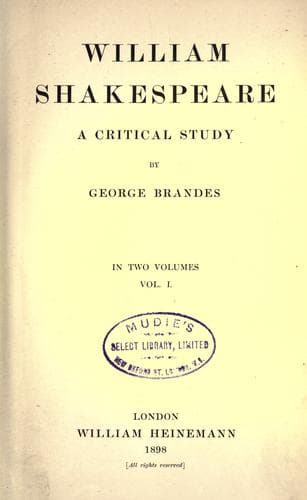
William Shakespeare: A Critical StudyBrandes, Georg
General
William Shakespeare: A Critical Study
Brandes, Georg
Shakespeare, William, 1564-1616 -- Criticism and interpretation
Shakespeare's great characteristic is precisely the resilience which
he gives to every word and to every speech. We take one step on earth,
and at the next we are soaring in air. His verse always tends towards a
rich and stately melody, is never flat or commonplace. In the English
historical plays, his diction sometimes verges upon the style of the
ballad or romance. There is a continual undercurrent of emotion, of
enthusiasm, or of pure fantasy, which carries us away with it. We are
always far remote from the humdrum monotony of everyday speech. For
everyday speech is devoid of fantasy, and all Shakespeare's characters,
with the exception of those whose humour lies in their stupidity, have
a highly-coloured imagination.
We could find no better proof of this than the diction of the
great work which he undertakes immediately after _The Merchant of
Venice_--the First Part of _Henry IV._
Harry Percy in this play is placed in opposition to the magniloquent,
visionary, thaumaturgic Glendower, as the man of sober intelligence,
who keeps to the common earth, and believes only in what his senses
aver and his reason accepts. But there is nevertheless a spring within
him which need only be touched in order to send him soaring into almost
dithyrambic poetry. The King (i. 3) has called Mortimer a traitor;
whereupon Percy protests that it was no sham warfare that Mortimer
waged against Glendower:--
"To prove that true,
Needs no more but one tongue for all those wounds,
Those mouthed wounds, which valiantly he took,
When on the gentle Severn's sedgy bank,
In single opposition, hand to hand,
He did confound the best part of an hour
In changing hardiment with great Glendower.
Three times they breath'd, and three times did they drink,
Upon agreement, of swift Severn's flood,
Who then, affrighted with their bloody looks,
Ran fearfully among the trembling reeds,
And hid his crisp head in the hollow bank
Blood-stained with these valiant combatants."
Thus Homer sings of the Scamander.
Worcester broaches to Percy an enterprise
"As full of peril and adventurous spirit,
As to o'er-walk a current, roaring loud,
On the unsteadfast footing of a spear;"
whereon Percy bursts forth:--
"Send danger from the east unto the west,
So honour cross it from the north to south,
And let them grapple:--O! the blood more stirs
To rouse a lion than to start a hare."
Northumberland then says of him that "Imagination of some great exploit
Drives him beyond the bounds of patience," and Percy answers:--
"By Heaven, methinks, it were an easy leap
To pluck bright honour from the pale-fac'd moon,
Or dive into the bottom of the deep,
Where fathom-line could never touch the ground,
And pluck up drowned honour by the locks."
Public-domain text, read in full here on John Shaqi.
Reviews
Reviews
No reviews yet
Be the first to share your thoughts on this work.
Elsewhere in the archive
Join the Discussion
Join the discussion
Sign in to leave a comment or review.
Sign InorCreate an account