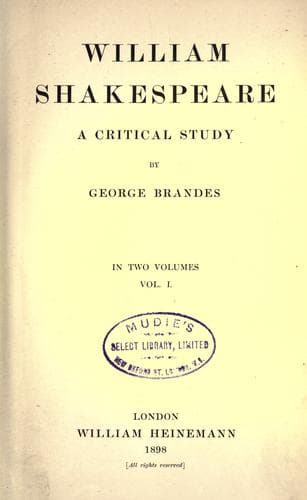
William Shakespeare: A Critical StudyBrandes, Georg
General
William Shakespeare: A Critical Study
Brandes, Georg
Shakespeare, William, 1564-1616 -- Criticism and interpretation
What a profusion of imagery is placed in the mouth of this despiser
of rhetoric and music! From the comparatively weak metaphor of the
speaking wounds up to actual myth-making! The river, affrighted by the
bloody looks of the combatants, hides its crisp head in the reeds--a
naiad fantasy in classic style. Danger, rushing from east to west,
hurtles against Honour, crossing it from north to south--two northern
Valkyries in full career. The wreath of honour is hung on the crescent
moon--a metaphor from the tilting-yard, expressed in terms of fairy
romance. Drowned Honour is to be plucked up by the locks from the
bottom of the deep--having now become, by a daring personification, a
damsel who has fallen into the sea and must be rescued. And all this in
three short speeches!
Where this irrepressible vivacity of fancy is lacking, as in _Arden of
Feversham_, Shakespeare's sign-manual is lacking along with it. Even
when his style appears sober and measured, it is saturated with what
may be called latent fantasy (as we speak of latent electricity), which
at the smallest opportunity bursts its bounds, explodes, flashes forth
before our eyes like the figures in a pyrotechnic set-piece, and fills
our ears as with the music of a rushing, leaping waterfall.[1]
In 1598 appeared a Quarto with the following title: _The History of
Henrie the Fovrth; With the battell at Shrewsburie, betweene the King
and Lord Henry Percy, surnamed Henrie Hotspur of the North. With the
humorous conceits of Sir John Falstaffe. At London. Printed by P. S.
for Andrew Wise, dwelling in Paules Churchyard, at the signe of the
Angell_. 1598. This was the First Part of Shakespeare's _Henry IV_.,
which must have been written in 1597--the play in which Shakespeare
first attains his great and overwhelming individuality. At the age
of thirty-three, he stands for the first time at the summit of his
artistic greatness. In wealth of character, of wit, of genius, this
play has never been surpassed. Its dramatic structure is somewhat
loose, though closer knit and technically stronger than that of the
Second Part. But, as a poetical creation, it is one of the great
masterpieces of the world's literature, at once heroic and burlesque,
thrilling and side-splitting. And these contrasted elements are not,
as in Victor Hugo's dramas, brought into hard-and-fast rhetorical
antithesis, but move and mingle with all the freedom of life.
When it was written, the sixteenth century, that great period in the
history of the human spirit, was drawing to its close; but no one had
then conceived the cowardly idea of making the end of a century a sort
of symbol of decadence in energy and vitality. Never had the waves of
healthy self-confidence and productive power run higher in the English
people or in Shakespeare's own mind. _Henry IV._, and its sequel _Henry
V._, are written throughout in a major key which we have not hitherto
heard in Shakespeare, and which we shall not hear again.
Public-domain text, read in full here on John Shaqi.
Reviews
Reviews
No reviews yet
Be the first to share your thoughts on this work.
Elsewhere in the archive
Join the Discussion
Join the discussion
Sign in to leave a comment or review.
Sign InorCreate an account