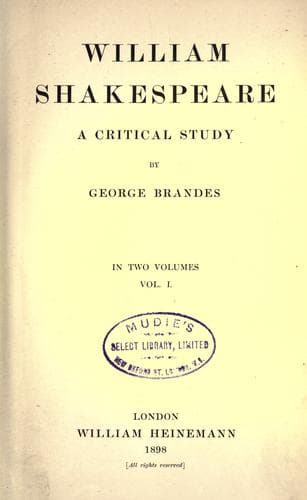
William Shakespeare: A Critical StudyBrandes, Georg
General
William Shakespeare: A Critical Study
Brandes, Georg
Shakespeare, William, 1564-1616 -- Criticism and interpretation
It is certain, of course, that neither Calderon nor Molière knew
anything of Shakespeare or of Falstaff; and Shakespeare, for his part,
was equally uninfluenced by any of his predecessors on the comic stage,
when he conceived his fat knight.
Nevertheless there is among Shakespeare's predecessors a great writer,
one of the greatest, with whom we cannot but compare him; to wit,
Rabelais, the masterspirit of the early Renaissance in France. He is,
moreover, one of the few great writers with whom Shakespeare is known
to have been acquainted. He alludes to him in _As You Like It_ (iii.
2), where Celia says, when Rosalind asks her a dozen questions and bids
her answer in one word: "You must borrow me Gargantua's mouth first:
'tis a word too great for any mouth of this age's size."
If we compare Falstaff with Panurge, we see that Rabelais stands to
Shakespeare in the relation of a Titan to an Olympian god. Rabelais is
gigantic, disproportioned, potent, but formless. Shakespeare is smaller
and less excessive, poorer in ideas, though richer in fancies, and
moulded with the utmost firmness of outline.
Rabelais died at the age of seventy, ten years before Shakespeare was
born; there is between them all the difference between the morning and
the noon of the Renaissance. Rabelais is a poet, philosopher, polemist,
reformer, "even to the very fire exclusively," but always threatened
with the stake. Shakespeare's coarseness compared with Rabelais's is as
a manure-bed compared with the _Cloaca Maxima_. Burlesque uncleanness
pours in floods from the Frenchman's pen.
His Panurge is larger than Falstaff, as Utgard-Loki is larger than
Asa-Loki. Panurge, like Falstaff, is loquacious, witty, crafty, and
utterly unscrupulous, a humorist who stops the mouths of all around him
by unblushing effrontery. In war, Panurge is no more of a hero than
Falstaff, but, like Falstaff, he stabs the foemen who have already
fallen. He is superstitious, yet his buffoonery holds nothing sacred,
and he steals from the church-plate. He is thoroughly selfish, sensual,
and slothful, shameless, revengeful, and light-fingered, and as time
goes on becomes ever a greater poltroon and braggart.
Pantagruel is the noble knight, a king's son, like Prince Henry. Like
the Prince, he has one foible: he cannot resist the attractions of low
company. When Panurge is witty, Pantagruel cannot deny himself the
pleasure of laughing at his side-splitting drolleries.
Public-domain text, read in full here on John Shaqi.
Reviews
Reviews
No reviews yet
Be the first to share your thoughts on this work.
Elsewhere in the archive
Join the Discussion
Join the discussion
Sign in to leave a comment or review.
Sign InorCreate an account