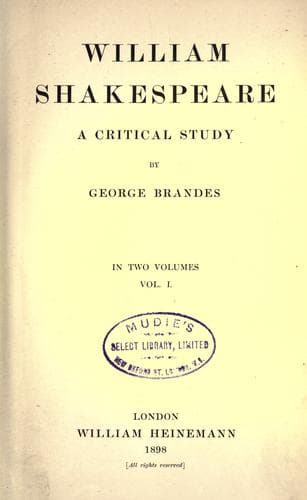
William Shakespeare: A Critical StudyBrandes, Georg
General
William Shakespeare: A Critical Study
Brandes, Georg
Shakespeare, William, 1564-1616 -- Criticism and interpretation
But Panurge, unlike Falstaff, is a satire on the largest scale. In
representing him as a notable economist or master of finance, who
calls borrowing credit-creating, and has 63 methods of raising money
and 214 methods of spending it, Rabelais made him an abstract and
brief chronicle of the French court of his day. In giving him a
yearly revenue from his barony of "6,789,106,789 royaulx en deniers
certain," to say nothing of the fluctuating revenue of the locusts and
periwinkles, "montant bon an mal an de 2,435,768 a 2,435,769 moutons
à la grande laine," Rabelais was aiming his satire direct at the
unblushing extortion which was at that time the glory and delight of
the French feudal nobility.
Shakespeare does not venture so far in the direction of satire. He is
only a poet, and as a poet stands simply on the defensive. The only
power he can be said to attack is Puritanism (_Twelfth Night, Measure
for Measure_, etc.), and that only in self-defence. His attacks, too, are
exceedingly mild in comparison with those of the cavalier poets before
the victory of Puritanism and after the reopening of the theatres. But
Shakespeare was what Rabelais was not, an artist; and as an artist he
was a very Prometheus in his power of creating human beings.
As an artist he has also the exuberant fertility which we find in
Rabelais, even surpassing him in some respects. Max Müller has long
ago remarked upon the wealth of his vocabulary. In this he seems to
surpass all other writers. An Italian opera-libretto seldom contains
more than 600 or 700 words. A well-educated modern Englishman, in
social intercourse, will rarely use more than 3000 or 4000. It has been
calculated that acute thinkers and great orators in England are masters
of as many as 10,000 words. The Old Testament contains only 5642 words.
Shakespeare has employed more than 15,000 words in his poems and
plays; and in few of the latter do we find such overflowing fulness of
expression as in _Henry IV._
Public-domain text, read in full here on John Shaqi.
Reviews
Reviews
No reviews yet
Be the first to share your thoughts on this work.
Elsewhere in the archive
Join the Discussion
Join the discussion
Sign in to leave a comment or review.
Sign InorCreate an account