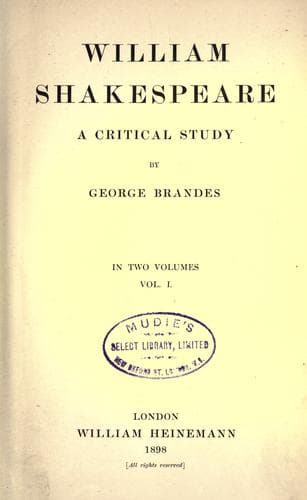
William Shakespeare: A Critical StudyBrandes, Georg
General
William Shakespeare: A Critical Study
Brandes, Georg
Shakespeare, William, 1564-1616 -- Criticism and interpretation
In the original form of the play, Falstaff's name, as already
mentioned, was Sir John Oldcastle. A trace of this remains in the
second scene of the first act (Part I.), where the Prince calls the fat
knight "my old lad of the castle." In the second scene of the second
act the line, "Away, good Ned, Falstaff sweats to death," is short of a
syllable, because the dissyllable Falstaff has been substituted for the
trisyllable Oldcastle. In the earliest Quarto of the Second Part, the
contraction _Old_. has been left before one of Falstaff's speeches; and
in Act ii. Sc. 2 of the same play, it is said of Falstaff that he was
page to Thomas Mowbray, Duke of Norfolk, a position which the historic
Oldcastle actually held. Oldcastle, however, was so far from being the
boon companion depicted by Shakespeare that he was, at the instance
of Henry V. himself, handed over to the Ecclesiastical Courts as an
adherent of Wicklif's heresies, and roasted over a slow fire outside
the walls of London on Christmas morning 1417. His descendants having
protested against the degradation to which the name of their ancestor
was subjected in the play, the fat knight was rechristened. Therefore,
too, it is stated in the Epilogue to the Second Part that the author
intends to produce a further continuation of the story, "where, for
anything I know, Falstaff shall die of a sweat ... _for Oldcastle died
a martyr, and this is not the man_."
Under the name of Falstaff he became, after the lapse of half a
century, the most popular of Shakespeare's creations. Between 1642 and
1694 he is more frequently mentioned than any other of Shakespeare's
characters. But it is noteworthy that in his own time, although
popular enough, he was not alluded to nearly so often as Hamlet, who,
up to 1642, is mentioned forty-five times to Falstaff's twenty; even
_Venus and Adonis_ and _Romeo and Juliet_ are mentioned oftener than
he, and _Lucrece_ quite as often.[3] The element of low comedy in his
figure made it, according to the notions of the day, obviously less
distinguished, and people stood too near to Falstaff to appreciate him
fully.
He was, as it were, the wine-god of merry England at the meeting of the
centuries. Never before or since has England enjoyed so many sorts of
beverages. There was ale, and all other kinds of strong and small beer,
and apple-drink, and honey-drink, and strawberry-drink, and three sorts
of mead (meath, metheglin, hydromel), and every drink was fragrant of
flowers and spiced with herbs. In white meath alone there was infused
rosemary and thyme, sweet-briar, pennyroyal, bays, water-cresses,
agrimony, marsh-mallow, liverwort, maiden-hair, betony, eye-bright,
scabious, ash-leaves, eringo roots, wild angelica, rib-wort, sennicle,
Roman wormwood, tamarisk, mother thyme, saxifrage, philipendula; and
strawberries and violet-leaves were often added. Cherry-wine and sack
were mixed with gillyflower syrup.[4]
Public-domain text, read in full here on John Shaqi.
Reviews
Reviews
No reviews yet
Be the first to share your thoughts on this work.
Elsewhere in the archive
Join the Discussion
Join the discussion
Sign in to leave a comment or review.
Sign InorCreate an account