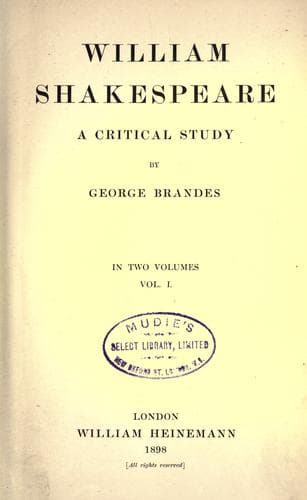
William Shakespeare: A Critical StudyBrandes, Georg
General
William Shakespeare: A Critical Study
Brandes, Georg
Shakespeare, William, 1564-1616 -- Criticism and interpretation
There were fifty-six varieties of French wine in use, and thirty-six
of Spanish and Italian, to say nothing of the many home-made kinds.
But among the foreign wines none was so famous as Falstaff's favourite
sherris-sack. It took its name from Xeres in Spain, but differed from
the modern sherry in being a sweet wine. It was the best of its kind,
possessing a much finer bouquet than sack from Malaga or the Canary
Islands (Jeppe paa Bjerget's, "Canari-Sæk")[5] although these were
stronger and sweeter. Sweet as it was too, people were in the habit of
putting sugar into it. The English taste has never been very delicate.
Falstaff always put sugar into his wine. Hence his words when he is
playing the Prince while the Prince impersonates the king (Pt. First,
ii. 4):--"If sack and sugar be a fault, God help the wicked." He puts
not only sugar but toast in his wine: "Go fetch me a quart of sack, put
a toast in it" _(Merry Wives_, iii. 5). On the other hand, he does not
like (as others did) to have it mulled with eggs: "Brew me a pottle of
sack ... simple of itself; I'll no pullet-sperm in my brewage" _(Merry
Wives_, iii. 5). And no less did he resent its sophistication with
lime, an ingredient which the vintners used to increase its strength
and make it keep: "You rogue, here's lime in this sack, too.... A
coward is worse than a cup of sack with lime in it" (I. _Henry IV_.,
ii. 4). Falstaff is as great a wine-knower and wine-lover as Silenus
himself. But he is infinitely more than that.
He is one of the brightest and wittiest spirits England has ever
produced. He is one of the most glorious creations that ever sprang
from a poet's brain. There is much rascality and much genius in him,
but there is no trace of mediocrity. He is always superior to his
surroundings, always resourceful, always witty, always at his ease,
often put to shame, but, thanks to his inventive effrontery, never put
out of countenance. He has fallen below his social position; he lives
in the worst (though also in the best) society; he has neither soul,
nor honour, nor moral sense; but he sins, robs, lies, and boasts, with
such splendid exuberance, and is so far above any serious attempt at
hypocrisy, that he seems unfailingly amiable whatever he may choose to
do. Therefore he charms every one, although he is a butt for the wit
of all. He perpetually surprises us by the wealth of his nature. He is
old and youthful, corrupt and harmless, cowardly and daring, "a knave
without malice, a liar without deceit; and a knight, a gentleman, and
a soldier, without either dignity, decency, or honour."[6] The young
Prince shows good taste in always and in spite of everything seeking
out his company.
Public-domain text, read in full here on John Shaqi.
Reviews
Reviews
No reviews yet
Be the first to share your thoughts on this work.
Elsewhere in the archive
Join the Discussion
Join the discussion
Sign in to leave a comment or review.
Sign InorCreate an account