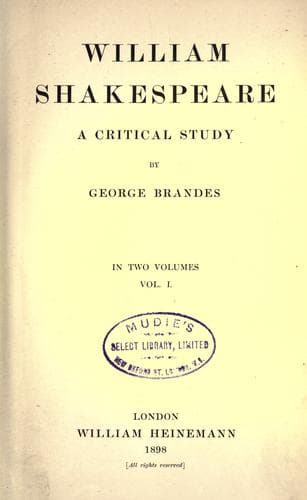
William Shakespeare: A Critical StudyBrandes, Georg
General
William Shakespeare: A Critical Study
Brandes, Georg
Shakespeare, William, 1564-1616 -- Criticism and interpretation
How witty he is in the brilliant scene where Shakespeare is daring
enough to let him parody in advance the meeting between Prince Henry
and his offended father! And with what sly humour does Shakespeare,
through his mouth, poke fun at Lyly and Greene and the old play of King
Cambyses! How delightful is Falstaff's unabashed self-mockery when he
thus apostrophises the hapless merchants whom he is plundering:--
"Ah! whoreson caterpillars! bacon-fed knaves! they hate us youth: down
with them; fleece them.... Hang ye, gorbellied knaves. Are ye undone?
No, ye fat chuffs; I would your store were here! On, bacons, on! What!
ye knaves, young men must live."
And what humour there is in his habit of self-pitying regret that his
youth and inexperience should have been led astray:--
"I'll be damned for never a king's son in Christendom.... I have
forsworn his company hourly any time this two-and-twenty years, and
yet I am bewitched with the rogue's company.... Company, villainous
company, hath been the spoil of me."
But if he has not been led astray, neither is he the "abominable
misleader of youth" whom Prince Henry, impersonating the King, makes
him out to be. For to this character there belongs malicious intent, of
which Falstaff is innocent enough. It is unmistakable, however, that
while in the First Part of _Henry IV._ Shakespeare keeps Falstaff a
purely comic figure, and dissipates in the ether of laughter whatever
is base and unclean in his nature, the longer he works upon the
character, and the more he feels the necessity of contrasting the moral
strength of the Prince's nature with the worthlessness of his early
surroundings, the more is he tempted to let Falstaff deteriorate. In
the Second Part his wit becomes coarser, his conduct more indefensible,
his cynicism less genial; while his relation to the hostess, whom he
cozens and plunders, is wholly base. In the First Part of the play he
takes a whole-hearted delight in himself, in his jollifications, his
drolleries, his exploits on the highway, and his almost purposeless
mendacity; in the Second Part he falls more and more under the
suspicion of making capital out of the Prince, while he is found in
ever worse and worse company. The scheme of the whole, indeed, demands
that there shall come a moment when the Prince, who has succeeded to
the throne and its attendant responsibilities, shall put on a serious
countenance and brandish the thunderbolts of retribution.
Public-domain text, read in full here on John Shaqi.
Reviews
Reviews
No reviews yet
Be the first to share your thoughts on this work.
Elsewhere in the archive
Join the Discussion
Join the discussion
Sign in to leave a comment or review.
Sign InorCreate an account