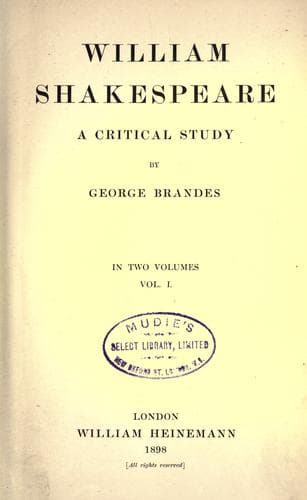
William Shakespeare: A Critical StudyBrandes, Georg
General
William Shakespeare: A Critical Study
Brandes, Georg
Shakespeare, William, 1564-1616 -- Criticism and interpretation
But Shakespeare's especial design was to present in him a master-type
of manliness. He is so profoundly, so thoroughly a man that he forms
the one counterpart in modern poetry to the Achilles of the Greeks.
Achilles is the hero of antiquity, Henry Percy of the Middle Ages. The
ambition of both is entirely personal and regardless of the common
weal. For the rest, they are equally noble and high-spirited. The one
point on which Hotspur is inferior to the Greek demigod is that of free
naturalness. His soul has been cramped and hardened by being strapped
into the harness of the feudal ages. Hero as he is, he is at the same
time a soldier, obliged and accustomed to be over-bold, forced to
restrict his whole activity to feuds and fights. He cannot weep like
Achilles, and he would be ashamed of himself if he could. He cannot
play the lyre like Achilles, and he would think himself bewitched if
he could be brought to admit that music sounded sweeter in his ears
than the baying of a dog or the mewing of a cat.[1] He compensates for
these deficiencies by the unyielding, restless, untiring energy of his
character, by the spirit of enterprise in his manly soul, and by his
healthy and amply justified pride. It is in virtue of these qualities
that he can, without shrinking, sustain comparison with a demigod.
So deep are the roots of Hotspur's character. Eccentric in externals,
he is at bottom typical. The untamed and violent spirit of feudal
nobility, the reckless and adventurous activity of the English race,
the masculine nature itself in its uncompromising genuineness, all
those vast and infinite forces which lie deep under the surface and
determine the life of a whole period, a whole people, and one half of
humanity, are at work in this character. Elaborated to infinitesimal
detail, it yet includes the immensities into which thought must plunge
if it would seek for the conditions and ideals of a historic epoch.
But in spite of all this, Henry Percy is by no means the hero of the
play. He is only the foil to the hero, throwing into relief the young
Prince's unpretentious nature, his careless sporting with rank and
dignity, his light-hearted contempt for all conventional honour, all
show and appearance. Every garland with which Hotspur wreathes his
helm is destined in the end to deck the brows of Henry of Wales. The
answer to Hotspur's question as to what has become of the madcap Prince
of Wales and his comrades, shows what colours Shakespeare has held in
reserve for the portraiture of his true hero. Even Vernon, an enemy of
the Prince, thus depicts his setting forth on the campaign (iv. I):--
Public-domain text, read in full here on John Shaqi.
Reviews
Reviews
No reviews yet
Be the first to share your thoughts on this work.
Elsewhere in the archive
Join the Discussion
Join the discussion
Sign in to leave a comment or review.
Sign InorCreate an account